Serbia Embassy Attestation from India: The Complete 2026 Guide to Apostille, Documents, Process & Fees
Everything you need to know before you send a single document — explained in plain English, with no missing steps.
If you've searched for "Serbia embassy attestation," you've probably noticed something frustrating: almost every result uses "apostille" and "embassy attestation" as if they mean the same thing. They don't always — and using the wrong one can cost you weeks of delay right when you're racing a visa interview or a university deadline.
This guide clears that up, and walks through everything else you actually need: which documents require attestation, the exact step-by-step process for educational, personal, and commercial documents, what work, study, and tourist visas require, how long it takes, what it costs, whether you need translation, and how Power of Attorney attestation works. There's also a 50+ question FAQ at the end covering the specific situations people usually get stuck on.

Table of Contents
- What Is Serbia Embassy Attestation and Why You Need It
- Documents That Typically Need Attestation for Serbia
- Apostille vs Embassy Attestation for Serbia — The Real Answer
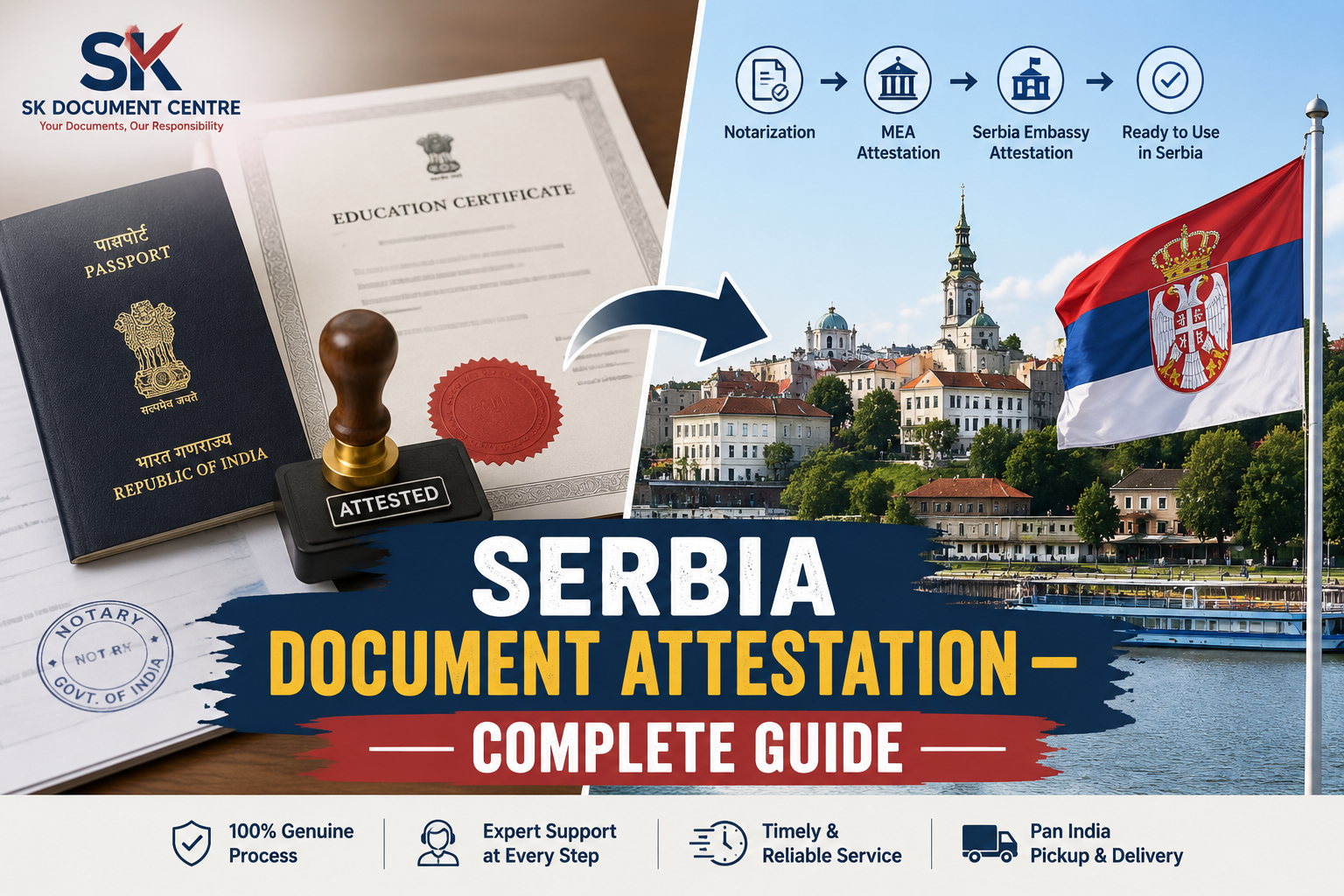
- Step-by-Step Attestation Process
- Documents Required by Visa Type
- How Long Does the Process Take
- What Does It Cost — Delhi vs Mumbai
- Do You Need Certified Translation
- Power of Attorney Attestation for Serbia
- Why Work Directly With a Document Attestation Center
- Frequently Asked Questions (50+)
What Is Serbia Embassy Attestation and Why You Need It
Serbia embassy attestation (more accurately, Serbia document apostille, as you'll see in the next section) is the process of getting your Indian-issued certificates officially verified so Serbian authorities, employers, universities, and immigration officers accept them as genuine.
An Indian degree certificate, birth certificate, or company registration document has no automatic legal standing outside India. Attestation is the chain of government-level checks — starting with a notary and ending with a seal from India's Ministry of External Affairs (MEA) — that confirms: this document is real, it was issued by who it says it was issued by, and the signatures on it are genuine. Without that chain, a Serbian university, employer, or immigration office has no way to trust an Indian-issued paper.
Who typically needs this service:
- Job seekers and professionals with a Serbian employment offer
- Students admitted to a Serbian university or college
- People applying for a Serbian residence permit or long-stay visa
- Indian businesses exporting to Serbia or opening a branch/liaison office there
- Individuals handling property, banking, or legal matters in Serbia through a Power of Attorney
- NRIs and Indian citizens returning to Serbia after time abroad
💬 Not Sure Which Documents You Need Attested?
SK Document Centre reviews your visa type, offer letter, or admission letter and tells you exactly what needs attestation — no guesswork, no over-paying for documents you don't need. Talk to an Attestation Expert →
Documents That Typically Need Attestation for Serbia
Attestation requirements depend on your purpose (work, study, business, or personal matters), but most cases fall into three categories.
Educational Documents
- Degree certificate / provisional degree certificate
- Diploma certificate
- Higher Secondary Certificate (12th / HSC)
- Secondary School Certificate (10th / SSC)
- Mark sheets / transcripts
- Certificate of migration / transfer certificate
These are almost always required for study visas and often for work visas where Serbia needs to confirm your qualification is genuine before issuing a work permit.
Personal Documents
- Birth certificate
- Marriage certificate
- Police Clearance Certificate (PCC) / character certificate
- Death certificate
- Single-status affidavit / affidavits of relationship
- Medical certificate (for some long-stay categories)
- Power of Attorney (POA)
These matter most for residence permits, family/dependent visas, marriage registration in Serbia, and work permits (PCC in particular is almost universally required for employment purposes).
Commercial Documents
- Certificate of Incorporation
- Memorandum & Articles of Association
- Board resolutions
- Power of Attorney (commercial)
- Certificate of Origin, invoices, and export paperwork
- Free Sale Certificates and other trade documents
These apply to business owners, exporters, and companies setting up operations, signing contracts, or trading with Serbian entities.
💡 Quick check: if your document was issued by a university or education board, it's "educational." If it was issued by a municipal or government office about you (birth, marriage, police record), it's "personal." If it was issued by or about a company, it's "commercial." This one distinction decides which state authority attests it before MEA — get it wrong and you'll have to restart that step.
Apostille vs Embassy Attestation for Serbia — The Real Answer
This is where almost every article on this topic — and most agencies — get vague. Here's the direct answer:
Serbia has been a member of the Hague Apostille Convention since 1965 (continued through succession after Yugoslavia's original accession). India has been a member since 2005. Because both countries are members, the Ministry of External Affairs, Government of India confirms that a document apostilled by MEA needs no further embassy legalisation to be treated as a legally verified document between the two countries.
In practice, this means: for the vast majority of purposes — university admission, visa applications, property matters, business registration — an MEA apostille is the complete and final step. You do not need to separately visit or courier documents to the Embassy of Serbia after apostille.
Where it gets more nuanced: some Serbian employers, immigration case officers, or specific municipal offices — particularly for work and residence permit applications — sometimes ask for an additional attestation stamp from the Embassy of the Republic of Serbia in New Delhi on top of the MEA apostille, even though this isn't strictly required under the Hague Convention. This isn't universal, and it isn't predictable from one case to another — it depends on the specific department or employer handling your file in Serbia.
Our recommendation: get the MEA apostille done first — it's mandatory either way. Then confirm with your university, employer, or the receiving authority in Serbia whether they specifically need an additional embassy attestation stamp. This avoids paying for and waiting on a step you may not need, while leaving you ready to add it quickly if it's requested.
💬 Confused About Apostille vs Embassy Attestation?
This is the single most common mix-up we resolve for clients every week. SK Document Centre will tell you — honestly — whether your specific case needs the embassy step or not, before you pay for it. Get a Free Document Review →
Step-by-Step Attestation Process
The exact chain depends on the document category. Here's each one in order.
For Educational Documents
- Notarisation — the certificate is notarised by a local Notary Public.
- State HRD Attestation — the State Human Resource Development (HRD) department (or the relevant Higher Education department, for degree certificates) verifies and stamps the document. For documents from private universities, this sometimes routes through the state's General Administration Department (GAD) instead.
- MEA Apostille — once state-level attestation is complete, MEA affixes the Apostille sticker, and the document is now valid for use in Serbia.
- (Only if specifically requested) Serbia Embassy Attestation — if your university or employer explicitly asks for it, the apostilled document is submitted to the Embassy of Serbia, New Delhi for an additional stamp.
Notary → State HRD/GAD Attestation → MEA Apostille → (Embassy, only if required)
For Personal Documents
- Notarisation of the document (where applicable — birth/marriage certificates issued by a government registrar typically skip straight to step 2).
- State Home Department / GAD / SDM Attestation — personal documents go through your state's Home Department or General Administration Department, or through a Sub-Divisional Magistrate (SDM) in Delhi, which is often the faster route.
- MEA Apostille — MEA affixes the apostille once state attestation is complete.
- (Only if specifically requested) Serbia Embassy Attestation — most common for work-permit and residence-permit cases where the employer or immigration office asks for it explicitly.
Notary → SDM / Home Department Attestation → MEA Apostille → (Embassy, only if required)
For Commercial Documents
- Notarisation of the company document.
- Chamber of Commerce (CoC) Attestation — the relevant Chamber of Commerce verifies and stamps commercial and trade documents. This step is unique to commercial paperwork and doesn't apply to personal or educational documents.
- MEA Apostille — MEA apostilles the document after CoC attestation.
- (Only if specifically requested) Serbia Embassy Attestation — occasionally requested for contracts tied to work permits for company-sponsored employees.
Notary → Chamber of Commerce (CoC) Attestation → MEA Apostille → (Embassy, only if required)
💬 Let Us Run the Full Chain for You
Chasing Notary, HRD/SDM/CoC, and MEA separately means multiple offices, multiple queues, and multiple chances for a document to sit in the wrong pile. SK Document Centre manages the entire chain end-to-end and keeps you updated at every stage. Start Your Attestation →
Documents Required by Visa Type (Work, Study, Tourist)
Work Visa / Work Permit
Serbian work permits are employer-sponsored, and document attestation is a core part of the file your employer submits on your behalf. You'll typically need apostilled/attested versions of:
- Highest qualification certificate (degree/diploma)
- Police Clearance Certificate (PCC)
- Employment contract (verified through your employer, not attested by you)
- Medical certificate, in some cases
- Passport copy and photographs (no attestation needed for these)
Because the employer and Serbian immigration office review qualification and character documents closely, this is the visa category most likely to also need the additional Embassy attestation step discussed above — so confirm with your employer's HR or immigration consultant early, before your documents are apostilled, so you're not doing it twice.
Study / Education Visa
Serbian universities and the visa process generally require:
- Educational certificates relevant to your admission (10th, 12th, degree/diploma as applicable)
- Birth certificate, in many cases
- Sometimes a medical certificate or vaccination record
Universities usually specify exactly which certificates they want apostilled as part of the admission or visa file — check your offer letter or admissions office instructions, since requirements can vary by institution.
Tourist Visa
Here's an important update many older guides miss: as of 1 January 2023, Serbia removed the visa-free entry arrangement for Indian passport holders. Indian nationals now need a visa (Type C / short-stay visa) to visit Serbia for tourism, even for short trips — the exception is if you hold a valid Schengen, UK, or US visa or residence permit, which allows visa-free entry for up to 90 days in a 180-day period.
For a standard tourist visa application, you generally do not need apostilled certificates. What's usually required instead is:
- Valid passport (with sufficient validity and blank pages)
- Visa application form and photographs
- Proof of sufficient funds (bank statements)
- Travel itinerary and confirmed accommodation
- Travel/health insurance covering the Schengen/Serbia area
- Invitation letter, if visiting for a private or business purpose
In short: attestation is a work/study/residence requirement, not a tourism requirement. If you're only visiting Serbia as a tourist, you can typically skip the entire attestation process — always double-check current requirements with VFS Global or the Embassy of Serbia, New Delhi, since visa rules can change.
How Long Does the Process Take
Timelines depend on which state-level route your document takes, not on Serbia's side of the process (which is fast once a properly apostilled document reaches Serbian hands).
| Step | Typical Timeline |
|---|---|
| Notarisation | Same day |
| SDM Attestation (personal documents) | 2–7 working days |
| State HRD/GAD Attestation (educational documents) | 15–30 working days (varies significantly by state) |
| Chamber of Commerce Attestation (commercial documents) | 3–7 working days |
| MEA Apostille | 2–5 working days after state attestation |
| Embassy Attestation (only if requested) | Add 5–10 working days |
Realistic total: 7–15 working days for personal/commercial documents via the SDM/CoC route, and 20–35 working days for educational documents via the HRD route. If your case also needs the additional Serbia Embassy step, add roughly another week to ten days on top.
If you're working against a tight visa interview or admission deadline, ask specifically about express/urgent processing — many attestation centers, including ours, offer a faster track for an additional fee, particularly on the SDM and MEA steps.
What Does It Cost — Delhi vs Mumbai
Government fees are fixed nationwide — the MEA apostille fee itself is roughly ₹50–90 per document. What varies is the pre-attestation step (Notary, SDM, HRD, or CoC) and the service/handling fee charged by whichever center processes your file.
| Component | Approximate Cost |
|---|---|
| Notary attestation | ₹100 – ₹200 per document |
| SDM attestation (personal documents) | ₹500 – ₹1,500 per document (varies) |
| State HRD/GAD attestation (educational) | ₹500 – ₹2,000+ government fee, state-dependent |
| Chamber of Commerce attestation | ₹1,500 – ₹2,500 per document |
| MEA apostille (government fee) | ₹50 – ₹90 per document |
| Agency service/handling charges | ₹1,000 – ₹4,000+ per document, depending on urgency and pickup/courier |
Total, all-inclusive, per document is typically ₹2,000–₹6,000 for personal or commercial documents, and can run higher — sometimes ₹8,000–₹15,000 — for educational documents that require the slower, more document-heavy HRD route. Costs rise with urgency (express processing), the number of documents in a single order (bundling multiple documents together reduces per-document courier costs), and whether the optional Embassy step is added.
Delhi vs Mumbai: government fees are identical in both cities, since MEA apostille is a central government fee. The real difference is logistics — Delhi gives direct access to the SDM offices and MEA's main processing point, while Mumbai residents can use the regional MEA-authorised processing center rather than couriering documents to Delhi. Either city works well; what matters more is choosing an experienced center that won't misroute your document to the wrong state authority.
💬 Get an Exact Quote for Your Documents
Because costs depend on document type, your state, and urgency, the fastest way to get an accurate number is to send us your document list. SK Document Centre gives you a transparent, itemised quote before you commit — no hidden charges added later. Request Your Free Quote →
Do You Need Certified Translation
Sometimes — it depends on the language of your original document and who's requesting it.
- If your certificate is already in English (which covers most Indian degree certificates, mark sheets, and government-issued documents), you generally do not need translation for the apostille process itself.
- If your document is in a regional Indian language (Hindi, Marathi, Tamil, and so on) — common for older birth certificates, marriage certificates, or certain state-issued records — you'll likely need a certified English translation before it can move through notarisation and state attestation.
- Once your apostilled document reaches Serbia, some universities, employers, or municipal offices may separately ask for a certified Serbian translation for their own internal use. This is usually arranged after apostille, either in India by a certified translator or in Serbia itself — check with the receiving institution, since practice varies.
Practical tip: get translation sorted before notarisation, not after. A translated-then-notarised document moves through the rest of the chain without needing to be redone, while attaching a translation after the fact can mean restarting the attestation sequence.
Power of Attorney Attestation for Serbia — Explained
A Power of Attorney (POA) lets someone in India act on your behalf — commonly used for property transactions, banking, business representation, or managing legal matters while you're in Serbia and can't be physically present in India.
How it works:
- Drafting — the POA is drafted on plain paper (Indian stamp paper isn't mandatory in every case, but check your specific transaction's requirement) clearly stating what powers you're granting and to whom.
- Signing — you sign the POA, along with two witnesses. If you're already in Serbia, this typically happens in front of a notary there, or at the Indian Embassy/Consulate.
- Notarisation — the document is notarised.
- Attestation route — a personal POA (property, banking, family matters) follows the personal document route: SDM/Home Department, then MEA apostille. A commercial POA (appointing someone to act for a business) follows the commercial route through the Chamber of Commerce instead.
- MEA Apostille — the final step that makes the POA valid for use between India and Serbia.
- Translation, if the POA needs to be understood by a Serbian authority in Serbian, is arranged after apostille.
Because a POA carries real legal and financial authority, small drafting errors (unclear wording, missing witness details, powers stated too broadly or too narrowly) are one of the most common reasons attestation gets delayed or rejected at the state-attestation stage — it's worth having the wording checked before you notarise, not after.
💬 Getting a POA Ready for Serbia?
SK Document Centre checks your POA draft, confirms whether it needs the personal or commercial route, and manages notarisation through MEA apostille from start to finish.Ask About POA Attestation →
Why Work Directly With a Document Attestation Center (Instead of Multiple Agents)
A lot of people going through this process for the first time end up dealing with two, sometimes three, separate middlemen — one "agent" for notary and SDM, another for HRD, another for MEA submission — each adding their own markup and their own delay while your document sits in transit between them. Here's what changes when you work with one direct, MEA-experienced document center instead:
- One point of contact, one file. You're not re-explaining your case to a new person at every stage, and no one can pass the blame to "the other agent" if something's delayed.
- No stacked middleman markup. Every extra agent in the chain adds their own margin on top of government fees. Going direct usually means a lower total cost for the same result.
- Accountability for the whole chain. If a document needs correction at the HRD stage, a direct center catches it before MEA submission — not after, when it's already been rejected and sent back.
- Real visibility into your file's status. You should always be able to ask "where is my document right now" and get a straight answer, not "we'll check and get back to you."
- Experience with Serbia specifically. Not every attestation center regularly handles Serbia-bound documents, and Hague-member countries like Serbia have a slightly different process from non-Hague countries such as UAE or Saudi Arabia. Working with a center that knows this distinction (see the apostille vs embassy attestation section above) saves you from paying for or waiting on a step you don't need.
SK Document Centre is a direct, MEA-experienced document attestation center — not a broker reselling another company's service. We manage your documents personally from notarisation through to MEA apostille and, where genuinely required, Serbia Embassy attestation, with clear pricing and status updates at every step.
💬 Ready to Get Started?
Send us a photo or scan of your documents and tell us your purpose (work, study, business, or personal) — we'll tell you exactly what's needed, what it costs, and how long it will take. Start Your Serbia Attestation Today →
Frequently Asked Questions
General Questions
1. What is Serbia embassy attestation?
It's the process of legally verifying Indian-issued documents so they're accepted as genuine by Serbian universities, employers, and immigration authorities. In most cases this is technically an MEA apostille rather than a traditional embassy attestation — see the section above for the full explanation.
2. Is apostille the same as embassy attestation for Serbia?
Not exactly. Apostille is a single certificate from India's MEA that both countries recognise under the Hague Convention. Embassy attestation is an additional stamp from the Serbian Embassy, needed only in specific cases (mainly some work/residence permit files), not as a general rule.
3. Why do I need my documents attested for Serbia?
Because an Indian document has no automatic legal standing outside India. Attestation is the official chain of verification that lets a Serbian authority trust that your certificate is genuine.
4. Is Serbia part of the Hague Apostille Convention?
Yes. Serbia has been a Hague Convention member since 1965 (via succession from the former Yugoslavia's original accession), and India has been a member since 2005.
5. Who needs Serbia document attestation?
Job seekers with a Serbian offer, students admitted to a Serbian institution, people applying for residence permits, businesses trading with or setting up in Serbia, and anyone using a Power of Attorney for property, banking, or legal matters in Serbia.
6. Can I use my Indian documents in Serbia without attestation?
Generally, no — for work, study, residence, or business purposes, unattested documents are typically rejected. Tourist visas are the main exception (see question 33).
7. What happens if I skip attestation or submit an incomplete one?
Your visa application, university admission file, or employer's work-permit submission can be delayed or rejected outright, since the receiving Serbian authority has no verified proof the document is genuine.
8. Is attestation the same as translation?
No. Attestation verifies authenticity; translation converts the document's language. You may need one, both, or neither, depending on your document's original language and the receiving authority's requirements (see the translation section above).
9. Do I need to visit Serbia's embassy myself?
Almost never for standard apostille — MEA handles that centrally. If your specific case needs the additional embassy stamp, an authorised attestation center can typically submit and collect on your behalf.
10. Is this process the same for all Hague Convention countries?
The core apostille process is similar, but the specific step order (which state department, whether embassy attestation is ever needed) varies by destination country's practice. This guide is specific to Serbia.
Documents & Eligibility
11. Which documents need attestation for Serbia?
Most commonly: degree/diploma certificates, birth certificates, marriage certificates, PCC, and — for businesses — incorporation certificates, board resolutions, and trade documents.
12. Does my degree certificate need apostille for Serbia?
Yes, if you're using it for a study or work visa, or for professional qualification recognition in Serbia.
13. Is birth certificate attestation mandatory for Serbia?
It's commonly required for residence permits, family/dependent visas, and sometimes study visas — check your specific visa category's document checklist.
14. Do I need marriage certificate attestation for Serbia?
Yes, typically for spouse/dependent visa applications or if you're registering your marriage with Serbian authorities.
15. Is PCC attestation required for Serbia?
Yes, for almost all work visa and long-stay residence applications, Serbia requires an apostilled Police Clearance Certificate as proof of no criminal record.
16. What is PCC and where do I get it?
A Police Clearance Certificate confirms you have no criminal record. In India, you can obtain it from your Regional Passport Office (RPO) or your local police station, depending on your situation.
17. Do commercial documents need attestation for Serbia?
Yes, if you're exporting goods, signing contracts, opening a branch office, or otherwise conducting formal business in Serbia.
18. What educational documents are commonly attested together?
Typically your highest qualification certificate plus supporting mark sheets/transcripts — check your university's or employer's exact list, since requirements vary by institution.
19. Do mark sheets need separate attestation from the degree certificate? Sometimes — some institutions want both attested, others only want the final degree certificate. Confirm with the receiving university or employer before submitting.
20. Can photocopies be attested, or do I need originals?
The apostille process requires your original document (or, in some cases, an original certified copy issued by the issuing authority). Plain photocopies alone are not accepted.
The Attestation Process
21. What is the attestation process for educational documents?
Notary → State HRD/GAD Attestation → MEA Apostille → Embassy Attestation only if specifically requested. Full detail is in the process section above.
22. What is the process for personal documents?
Notary → SDM or State Home Department Attestation → MEA Apostille → Embassy Attestation only if specifically requested.
23. What is the process for commercial documents?
Notary → Chamber of Commerce Attestation → MEA Apostille → Embassy Attestation only if specifically requested.
24. What is SDM attestation?
Attestation by a Sub-Divisional Magistrate — a faster alternative to Home Department attestation for personal documents, commonly used for documents processed through Delhi.
25. What is HRD attestation?
State-level attestation by the Human Resource Development department (or Higher Education department), specifically for educational certificates, before MEA apostille.
26. What is the Chamber of Commerce's role in attestation?
It verifies and stamps commercial and trade documents before they go to MEA — this step applies only to commercial documents, not personal or educational ones.
27. What is MEA apostille?
The final certification from India's Ministry of External Affairs confirming a document is legitimate for use in any Hague Convention member country, including Serbia.
28. Do I always need notary attestation first?
For most personal and educational documents, yes. Some government-registrar-issued documents (like certain birth certificates) can occasionally skip straight to state attestation — an experienced center can confirm this for your specific document.
29. Can I go directly to SDM and skip HRD for educational documents?
Generally no — educational documents are meant to go through HRD/GAD, since that department verifies them against the issuing institution. SDM is typically for personal documents.
30. What is e-SANAD?
A Government of India digital portal that allows certain attestation and apostille applications to be submitted online, reducing physical paperwork for some document categories.
Visa-Specific Questions
31. What documents are needed for a Serbia work visa?
Apostilled qualification certificate, apostilled PCC, your employment contract, and sometimes a medical certificate — see the work visa section above for the full list.
32. What documents are needed for a Serbia study visa?
Apostilled educational certificates relevant to your admission, often a birth certificate, and sometimes medical documentation — your university's admission office will confirm the exact list.
33. Do I need attestation for a Serbia tourist visa?
Generally no. Tourist visas rely on passport, funds proof, travel itinerary, and insurance — not attested certificates.
34. Do Indian citizens need a visa to visit Serbia?
Yes — as of 1 January 2023, Serbia removed visa-free entry for Indian passport holders, except for those holding a valid Schengen, UK, or US visa/residence permit.
35. What documents are needed for a Serbia residence permit?
Typically an apostilled birth certificate, PCC, and — depending on the permit category — marriage certificate or educational certificates. Requirements vary by the specific permit type.
36. What does my employer need for a Serbia work permit application?
Usually your apostilled qualification certificate and PCC; the employer separately handles the labour-market clearance and permit paperwork on their end.
37. What is needed for a Serbia family or dependent visa?
An apostilled marriage certificate (for a spouse) or birth certificate (for children), alongside the sponsoring family member's valid residence/work permit documentation.
38. Is medical certificate attestation required for Serbia?
It depends on your visa category — some long-stay permits request it, while tourist and short business visas generally don't. Check your specific visa checklist.
Cost & Timelines
39. How much does Serbia embassy attestation cost overall?
All-inclusive, expect roughly ₹2,000–₹6,000 per personal or commercial document, and ₹8,000–₹15,000 for educational documents via the HRD route — see the full cost breakdown above.
40. What is the MEA apostille government fee? Approximately ₹50–90 per document — this is the fixed government charge, separate from notary, state attestation, and agency service fees.
41. How long does the whole process take?
Roughly 7–15 working days for personal/commercial documents, and 20–35 working days for educational documents through the HRD route — longer if the additional embassy step is needed.
42. Which is faster — SDM or HRD?
SDM, generally by a wide margin (a few days versus several weeks) — but it's typically only an option for personal documents, not educational ones.
43. Can I get same-day or urgent attestation?
Some steps can be expedited for an additional fee, particularly SDM and MEA processing. HRD timelines are harder to compress since they involve state-level verification with the issuing institution.
44. Why do agency charges vary so much between providers?
Because quotes bundle different things — some include notary, courier, and urgent processing; others quote only the state-attestation fee and add extras later. Always ask for an itemised breakdown.
45. Is the cost different in Delhi vs Mumbai?
Government fees are identical nationwide. The difference is mainly logistics — which city's processing center handles your file and courier costs to reach it.
46. Are there hidden charges I should watch for?
Courier/pickup fees, urgent-processing surcharges, and translation costs are the most commonly missed items in a quote — ask for these upfront.
Translation & Power of Attorney
47. Do I need translation for Serbia attestation?
Only if your original document isn't in English — most Indian degree certificates and government documents already are. See the translation section above for details.
48. Does Serbia require documents in Serbian language?
Sometimes, for specific institutional or municipal use after your document arrives in Serbia — this is usually arranged separately from the Indian attestation process.
49. What is Power of Attorney attestation, and why would I need it?
It's the process of legally verifying a POA so someone in India can act on your behalf for property, banking, or business matters while you're in Serbia. Full process above.
50. Do I need POA attestation for property matters in Serbia?
If you're granting someone authority to handle Indian property or legal matters while you're based in Serbia, yes — the POA itself needs attestation to be legally valid.
51. How is POA attestation different from other personal documents?
The core steps are similar, but POA wording is legally sensitive — errors in drafting are a common cause of delay, so it's worth having the draft checked before notarisation.
52. Can I get documents attested for my family from abroad?
Yes — many attestation centers, including ours, accept documents couriered from within India on your family's behalf, with the process coordinated remotely if you're already in Serbia.
Practical Questions
53. Do I need to be physically present for the attestation process?
No — once you provide your original documents (by courier or in person) and any required ID, the entire chain can be handled on your behalf.
54. Can I submit documents from outside Delhi or Mumbai?
Yes — documents can be couriered from anywhere in India for processing; you don't need to live in or travel to either city.
55. What if my document has an error or name mismatch?
It needs to be corrected at the source (the issuing university, municipal office, etc.) before attestation — attestation confirms authenticity, but it can't fix an underlying error on the certificate itself.
56. How long is an apostille valid for?
The apostille itself doesn't expire, but many receiving institutions prefer documents apostilled within the last 6–12 months, so timing your attestation close to your application matters.
57. Can attestation be rejected? What happens if it is?
Yes — usually due to mismatched details, an unclear signature/seal on the original, or the wrong attestation route being used. A rejected document is typically returned with the reason, and can be resubmitted after correction.
58. How do I track my documents during the process?
A good attestation center should be able to tell you which stage your document is at, on request, at any point — ask about tracking or status updates before you commit to a provider.
59. Why should I choose SK Document Centre over other agencies?
We work directly — not as a reseller — with hands-on Serbia-specific experience, transparent itemised pricing, and a single point of contact managing your file from notary through to MEA apostille (and embassy attestation, if genuinely needed).
60. How do I get started?
Send us clear photos or scans of your documents along with your purpose (work, study, business, or personal), and we'll confirm exactly what's required, the cost, and the timeline before you send anything by courier.
Conclusion
Serbia's Hague Convention membership actually makes this process more straightforward than many countries — an MEA apostille is the mandatory, sufficient step for the overwhelming majority of cases, and the extra Serbia Embassy attestation is the exception, not the rule. The part that trips people up isn't the paperwork itself; it's not knowing which of the three routes (educational, personal, or commercial) their document belongs to, and whether their specific employer or institution is one of the ones that asks for that extra embassy step.
Get that right from the start, and the rest is a predictable, trackable chain: Notary → state attestation → MEA apostille → done.
💬 Let's Get Your Serbia Documents Sorted
Whether it's a single degree certificate or a full set of personal, educational, and commercial documents, SK Document Centre handles the complete Serbia attestation process — accurately, transparently, and with real people you can reach for a status update. Contact Us for a Free Consultation → | 📞 [Call/WhatsApp: +91-9310970010] | 📍 Delhi & Mumbai