When people search for apostille vs embassy attestation, they usually have one common question: “Which attestation is required for abroad?” The confusion is normal because different countries ask for different verification routes.
Some countries accept apostille attestation, some require embassy attestation, and in many cases MEA attestation is an important step before the final document is accepted. The right process depends on your destination country, document type and purpose.
What Is Document Attestation?
Document attestation means verifying a document so it can be legally accepted by an authority, employer, university, embassy or government department in another country.
For example, if you are going abroad for a job, education, business setup, family visa, marriage registration or immigration, the foreign authority may ask you to prove that your Indian certificate is genuine.
Common documents that need attestation
- Degree certificate, diploma and marksheet
- Birth certificate and marriage certificate
- Police Clearance Certificate
- Single Status Certificate
- Power of Attorney and affidavits
- Commercial invoice, company documents and board resolution
What Is MEA Attestation?
MEA attestation is authentication done by the Ministry of External Affairs in India. It confirms that the signature, seal or stamp of the concerned state authority, HRD department, SDM or Chamber of Commerce is genuine.
MEA usually does not verify the content of your certificate directly. It verifies the previous authority’s authentication. That is why pre-verification is very important.
Where MEA fits in the process
- For apostille countries, MEA issues the apostille sticker or e-apostille.
- For non-apostille countries, MEA attestation is usually done before embassy attestation.
- For commercial documents, Chamber of Commerce verification often comes before MEA.
What Is Apostille Attestation?
Apostille attestation is a simplified international document legalization process for countries that are members of the Hague Apostille Convention.
Once a document is apostilled by MEA, it is generally accepted in Hague Convention countries without embassy legalization. This makes the process faster and simpler compared to embassy attestation.
Examples where apostille may be required
- Portugal, Italy, Germany, Spain, France and Netherlands
- Ireland, Australia and many European countries
- Study admission, employment, marriage, visa or migration use
For example, if someone asks for Irish document attestation for Indian documents to be used in Ireland, the usual route is apostille because Ireland is a Hague Convention country.
What Is Embassy Attestation?
Embassy attestation is the process where the embassy or consulate of the destination country legalizes your document after required Indian-level authentication.
This is needed when the destination country does not accept apostille or has its own embassy legalization requirement.
Embassy Attestation is commonly required for
- Employment visa
- Family visa
- Business setup
- Company registration abroad
- Medical, legal or immigration submission
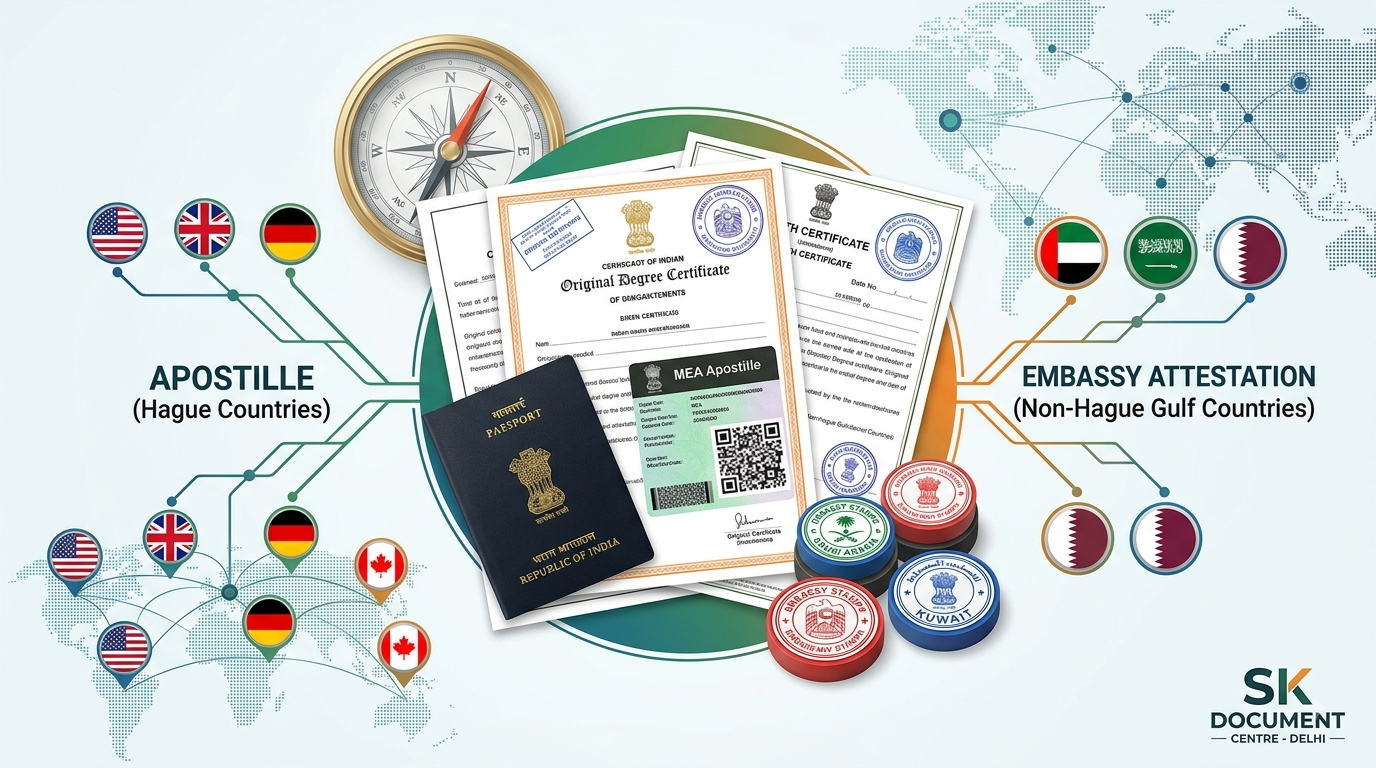
Apostille vs Embassy Attestation vs MEA Attestation: Quick Comparison
| Point | Apostille | MEA Attestation | Embassy Attestation |
|---|---|---|---|
| Meaning | International authentication for Hague countries | Authentication by Ministry of External Affairs, India | Legalization by destination country embassy |
| Used For | Hague Convention countries | Both apostille and embassy routes | Non-Hague or embassy-required countries |
| Final Authority | MEA apostille | MEA | Foreign embassy or consulate |
| Embassy Required? | No, in most Hague countries | Sometimes, depending on country | Yes |
| Common Purpose | Study, job, marriage, migration | Step before apostille or embassy | Visa, employment, family or business use |
| Processing Route | State/SDM/HRD/CoC → MEA Apostille | State/SDM/HRD/CoC → MEA | State/SDM/HRD/CoC → MEA → Embassy |
Apostille vs Attestation: What Is the Real Difference?
The term apostille vs attestation creates confusion because apostille is also a type of authentication. The difference is mainly based on the country where the document will be used.
Apostille is for Hague Convention countries. Attestation is a broader term and may include notary, state, HRD, SDM, MEA and embassy verification.
Embassy Attestation vs Apostille: Which One Do You Need?
The easiest way to decide between embassy attestation vs apostille is to check the destination country’s requirement.
- If the country accepts Hague apostille, choose apostille.
- If the country asks for embassy legalization, choose embassy attestation.
- If the receiving authority gives a checklist, follow that checklist carefully.
- If you are unsure, get the document route checked before submitting originals.
Country-Based Examples
Vietnam
The standard sequence document attestation India for Vietnam may include notary or state-level verification, MEA attestation and Vietnam embassy attestation, depending on document type and purpose.
Ireland
For Indian documents used in Ireland, apostille is commonly required because Ireland accepts Hague apostille. Embassy attestation is usually not the normal route.
China
China’s document legalization requirements changed after joining the Apostille Convention. Still, people search for China embassy attestation because older checklists and some cases may create confusion. Always verify current requirements before processing.
Standard Document Attestation Sequence in India
The exact sequence changes according to the document and destination country. However, most routes follow this pattern:
- Document review: Check spelling, name, date, stamp and issuing authority.
- Notary or local verification: Required for some personal, legal or commercial documents.
- State/HRD/SDM/Chamber verification: Depends on document category.
- MEA attestation or apostille: Done after pre-authentication.
- Embassy attestation: Required only where the destination country asks for it.
When Is Each Attestation Required?
Apostille is required when:
- Your destination is a Hague Convention country.
- You need documents for education, job, marriage or migration.
- The foreign authority specifically asks for apostille.
MEA attestation is required when:
- Your document needs central government authentication in India.
- You are moving toward embassy attestation.
- You need MEA authentication for non-Hague country submission.
Embassy attestation is required when:
- The destination country does not accept apostille.
- The embassy specifically asks for document legalization.
- You are applying for employment, family visa or business documentation in that country.
How to Avoid Rejection or Delay
- Check the destination country before choosing apostille or embassy attestation.
- Match your name, parents’ name, date of birth and passport details.
- Do not submit damaged, laminated or unclear documents without checking.
- Confirm whether original documents or true copies are required.
- Use the correct route for educational, personal and commercial documents.
Looking for Document Attestation?
If you are searching for document attestation near me, make sure you choose a service provider who first checks your country requirement instead of directly starting the process.
At SK Document Centre, we help you understand whether you need apostille, MEA attestation or embassy attestation. This saves time, avoids wrong processing and reduces the chance of rejection.
Need Help Choosing the Right Attestation?
Share your destination country, document type and purpose. Our team will guide you with the correct process for apostille, MEA attestation or embassy attestation.
Call / WhatsApp for Document ReviewFAQs
1. What is the main difference between apostille and embassy attestation?
Apostille is for Hague Convention countries, while embassy attestation is for countries where apostille is not accepted or where embassy legalization is specifically required.
2. Is MEA attestation the same as apostille?
No. MEA attestation and apostille are not exactly the same. Apostille is issued by MEA for Hague countries, while MEA attestation can also be part of the route for embassy attestation.
3. Which attestation is required for abroad?
It depends on your destination country. Hague countries usually require apostille. Non-Hague countries or embassy-specific cases may require MEA attestation followed by embassy attestation.
4. Do educational certificates need apostille or embassy attestation?
Educational documents may need HRD or SDM verification first. After that, they can go for MEA apostille or embassy attestation based on the destination country.
5. Can I do embassy attestation without MEA attestation?
In most cases, embassy attestation requires prior authentication from Indian authorities, including MEA. The final route depends on the embassy’s rules and document type.