What is First Class Magistrate Attestation?
When you need to submit important documents for legal, government, or official purposes, you may be asked for First Class Magistrate Attestation. Many people are confused about what this process means and why a magistrate’s signature is required.
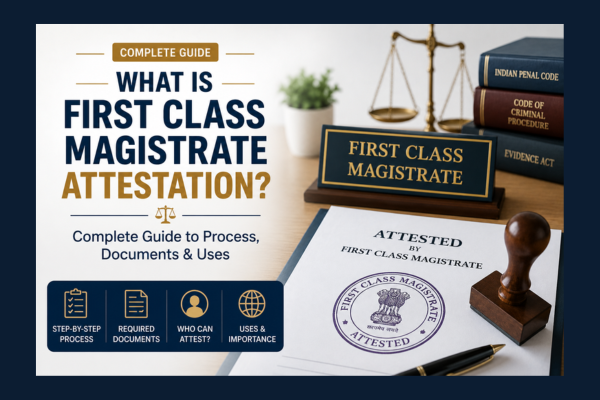
In simple words, First Class Magistrate Attestation is the process of getting a document verified and certified by a Judicial First Class Magistrate (JMFC). The magistrate checks the document or declaration, verifies the required details, and provides an official signature and stamp.
This attestation gives additional authenticity to documents and is commonly required for legal documents, affidavits, government applications, court matters, educational verification, and some immigration-related purposes.
Knowing the correct process of First Class Magistrate Attestation can help you avoid delays, rejection, and unnecessary visits.
Who is a First Class Magistrate?
A First Class Magistrate, also known as a Judicial Magistrate First Class (JMFC), is a judicial officer appointed under the Indian judicial system. They are empowered to hear certain criminal cases, administer oaths, and verify legal documents where permitted by law.
Unlike a notary public, a First Class Magistrate functions under the judiciary and possesses broader legal authority for judicial and document verification matters.
Key Responsibilities of a First Class Magistrate
- Hearing criminal cases within their jurisdiction.
- Recording statements and affidavits.
- Certifying legal declarations.
- Attesting documents where legally required.
- Issuing judicial orders in specific matters.
Why is First Class Magistrate Attestation Required?
Not every document requires magistrate attestation. However, certain government departments, courts, educational institutions, or foreign authorities may specifically ask for First Class Magistrate Attestation.
The requirement depends on the purpose of the document and the authority requesting verification.
Common Situations Where Magistrate Attestation May Be Required
- Legal affidavits
- Court-related documentation
- Name change declarations
- Property-related matters
- Adoption procedures
- Marriage-related legal documents
- Educational document verification
- Immigration or visa-related requirements
- Government recruitment processes
- Identity verification in special cases
The exact requirement for First Class Magistrate Attestation depends on the department, institution, court, or authority asking for document verification.
Documents That Can Be Attested by a First Class Magistrate
A First Class Magistrate may attest various personal, educational, and legal documents depending on the purpose and requirement of the authority.
| Document | Can be Attested? |
|---|---|
| Birth Certificate | ✅ Yes |
| Marriage Certificate | ✅ Yes |
| Educational Certificates | ✅ Yes |
| Mark Sheets | ✅ Yes |
| Affidavits | ✅ Yes |
| Identity Proof | ✅ Yes |
| Address Proof | ✅ Yes |
| Passport Copies | ✅ Yes (where accepted) |
| Property Documents | Depending on the case |
| Legal Declarations | ✅ Yes |
Always confirm with the requesting authority whether First Class Magistrate Attestation is specifically required before proceeding.
First Class Magistrate Attestation Process
The process is usually straightforward if your documents are complete and all required supporting documents are available.
Step 1: Collect Your Documents
Keep both the original documents and photocopies ready before starting the attestation process.
Step 2: Carry Valid Identity Proof
Bring an original identity document such as Aadhaar Card, Passport, PAN Card, or Driving Licence.
Step 3: Visit the Appropriate Court
Go to the court where a Judicial First Class Magistrate (JMFC) is available.
Step 4: Submit Your Documents
Present your original documents, photocopies, and supporting documents for verification.
Step 5: Verification
The magistrate or court staff verifies your identity and checks the authenticity of documents.
Step 6: Attestation
After verification, the magistrate signs, stamps, and officially attests the required documents.
Step 7: Collect the Documents
Collect your attested documents for submission to the concerned authority.
Documents Required for First Class Magistrate Attestation
Although requirements may vary slightly depending on the purpose and authority, you generally need the following documents for First Class Magistrate Attestation.
Original Document
Carry the original document that needs to be verified and attested.
Photocopies
Keep self-attested photocopies of all required documents.
Identity Proof
Aadhaar Card, PAN Card, or other valid identity documents may be required.
Passport
Passport may be required for international or immigration-related purposes.
Photographs
Carry recent passport-size photographs if required.
Supporting Documents
Additional documents, affidavits, or application forms may be required depending on the case.
Additional Documents That May Be Required
- Aadhaar Card
- PAN Card (if applicable)
- Passport (for international purposes)
- Passport-size photographs
- Supporting documents
- Affidavit (if required)
- Application form (where applicable)
Helpful Tip:Keeping extra photocopies of your documents can save time and help avoid delays during the attestation process.
Keeping extra photocopies of your documents can save time and help avoid delays during the attestation process.
How Long Does First Class Magistrate Attestation Take?
The time required for First Class Magistrate Attestation depends on the court's workload and the complexity of your case. Simple document verification is often completed quickly, while legal matters may require additional time.
| Type of Request | Estimated Processing Time |
|---|---|
| Simple Document Attestation | Same Day |
| Affidavits | Same Day or Next Working Day |
| Complex Legal Matters | 2–5 Working Days |
Visit the court during working hours and carry all original documents, photocopies, identity proof, and supporting documents. This helps avoid repeat visits and speeds up the attestation process.
What is the Cost of First Class Magistrate Attestation?
There is no fixed fee for First Class Magistrate Attestation across India. The overall cost depends on the nature of your documents, the state in which the attestation is carried out, and whether legal assistance is required.
Expenses That May Be Involved
- Court-related charges (where applicable)
- Affidavit drafting charges
- Stamp paper cost
- Advocate's professional fee (if legal assistance is taken)
The total cost varies depending on the state, the type of documents, and the specific legal requirements. It is advisable to confirm the applicable charges with the concerned court or legal professional before beginning the attestation process.
Difference Between First Class Magistrate Attestation and Notary Attestation
Many people confuse First Class Magistrate Attestation with Notary Attestation. While both involve document verification, they are performed by different authorities and serve different legal purposes.
Always follow the requirement specified by the requesting authority. If a department or court specifically asks for First Class Magistrate Attestation, a Notary Attestation will generally not be accepted as a substitute.
First Class Magistrate Attestation vs Gazetted Officer Attestation
Although both authorities can verify documents, their roles, legal powers, and areas of application are different. Understanding these differences helps you choose the correct type of attestation based on the requirements of the requesting authority.
| First Class Magistrate Attestation | Gazetted Officer Attestation |
|---|---|
| Performed by a Judicial First Class Magistrate (JMFC) | Performed by a Gazetted Government Officer |
| Functions under the judiciary | Functions under a government department |
| Primarily used for legal and court-related matters | Primarily used for document verification and certification |
| Uses an official judicial seal and signature | Uses an official departmental seal and signature |
| Suitable for affidavits, court proceedings, and legal declarations | Suitable for educational admissions, government recruitment, and routine official applications |
First Class Magistrate Attestation vs SDM Attestation
Although both involve government authorities, their purposes differ.
| First Class Magistrate | SDM Attestation |
|---|---|
| Judicial authority | Executive authority |
| Handles legal verification | Handles administrative verification |
| Court-based process | Revenue administration process |
| Used for judicial purposes | Often required for certificate attestation |
Is First Class Magistrate Attestation Valid Forever?
The attestation itself does not usually expire. However, the acceptance of an attested document depends on the authority requesting it.
For Example
- Some departments accept recently attested documents only.
- Foreign authorities may require additional authentication.
- Certain government applications have specific validity periods.
Always check the latest requirements before submitting your documents to ensure your attestation is accepted by the concerned authority.
Is First Class Magistrate Attestation Accepted Abroad?
In some cases, yes.
However, for documents being used outside India, First Class Magistrate Attestation alone is often not sufficient.
You May Also Need
- State Authentication
- MEA Attestation
- Apostille
- Embassy or Consulate Attestation
The exact process depends on the destination country and the purpose of the documents. Always verify the documentation requirements before submitting your papers for international use.
Tips Before Visiting a First Class Magistrate
Before you visit the court, keep this checklist handy:
- ✔ Carry original documents.
- ✔ Bring multiple photocopies.
- ✔ Keep valid photo ID.
- ✔ Arrange supporting documents.
- ✔ Confirm office timings.
- ✔ Verify whether magistrate attestation is actually required.
- ✔ Keep passport-size photographs ready.
Being well-prepared helps complete the process smoothly.
Frequently Asked Questions
1. What is First Class Magistrate Attestation?
First Class Magistrate Attestation is the official verification and certification of documents by a Judicial First Class Magistrate for legal or administrative purposes.
2. Is First Class Magistrate Attestation the same as notarization?
No. A notary public and a First Class Magistrate have different legal powers. Magistrate attestation is generally required for specific legal matters, while notarization is commonly used for routine document verification.
3. Which documents can be attested by a First Class Magistrate?
Educational certificates, birth certificates, marriage certificates, affidavits, identity proofs, address proofs, and several legal documents may be attested depending on the purpose.
4. How long does the attestation process take?
Simple cases are often completed on the same day, while more detailed legal matters may take a few working days.
5. Is First Class Magistrate Attestation accepted for international use?
It may be accepted as part of the documentation process, but many countries also require MEA Attestation, Apostille, or Embassy Attestation before the documents are considered valid abroad.
Final Thoughts
Understanding what First Class Magistrate Attestation is can help you complete legal and official documentation without unnecessary delays. While many people assume that notarization or gazetted officer attestation is enough, some authorities specifically require verification from a Judicial First Class Magistrate.
Before submitting your documents, always confirm the exact attestation requirement with the concerned department or institution. This simple step can save time, reduce the chances of rejection, and make the entire process much smoother.
Need Professional Assistance with Document Attestation?
SK Document Centre can help you understand the correct attestation process and guide you through the documentation requirements, ensuring your documents are prepared accurately for use in India or abroad.
Get expert guidance for your document attestation needs