All Articles / Apostille

What Is Apostille and When Do You Need It?

SK Admin 05 Jul 2026 6 min read Apostille
What Is Apostille and When Do You Need It?

If a country has asked you for an "apostille" and you're not sure what that means, you're not alone. Here's what it actually is, how it works, and when you need one.

Quick Answer

An apostille is a standardized certificate that verifies a document's authenticity for use in another country, but only among countries that are part of the 1961 Hague Apostille Convention. You need one whenever a Hague-member country asks for your certificate — for study, work, marriage, or business — to confirm it hasn't been altered and was issued by a legitimate authority. If your destination country isn't part of the Hague Convention, you'll need embassy attestation instead.

Apostille comes up constantly in visa applications, university admissions, and job offers abroad, but the term itself is rarely explained well. It sounds bureaucratic because it is — but the concept behind it is actually pretty simple once you see how it fits into the bigger picture of document verification.

This guide covers what an apostille actually does, how it's different from attestation, which documents typically need one, and how to tell whether your situation calls for it. If you're also trying to figure out timelines, our guide on how long certificate attestation takes in India breaks down realistic processing times for both apostille and embassy attestation.

What Does "Apostille" Actually Mean?

In Simple Terms

An apostille is a single certificate — usually a stamp or attached page — issued by a designated authority in the country where your document originated. It confirms that the signature, seal, or stamp on your document is genuine, so that a receiving country doesn't need to separately verify it through its own embassy. It's essentially a shortcut that Hague Convention member countries agreed to use with each other, instead of requiring full embassy-by-embassy verification. The full text of the convention and the current list of member countries is maintained by the Hague Conference on Private International Law (HCCH).

Apostille vs. Embassy Attestation: What's the Difference?

These two terms get used interchangeably, but they're not the same process — and knowing which one applies to you matters, because they follow different steps and timelines. If your document is headed to a non-Hague country such as the UAE, Saudi Arabia, or Qatar, it will need embassy attestation rather than an apostille. Errors in either process are also a leading cause of rejected applications; see our breakdown of common reasons documents get rejected during attestation for what to watch out for.

Apostille

A single-stage certificate accepted by all Hague Convention member countries. No embassy visit is required once the apostille is issued.

Embassy Attestation

A multi-stage process required for non-Hague countries, where the destination country's embassy or consulate must separately verify the document.

When Do You Actually Need an Apostille?

Whether you need an apostille depends entirely on where your document is going, not what type of document it is. If the destination country is a Hague Convention member, an apostille is usually all that's required. Common situations where people are asked for one include:

Studying Abroad

Universities in Hague-member countries often ask for apostilled transcripts, degrees, or mark sheets during admission.

Working Overseas

Employers or immigration authorities may require an apostilled degree, experience letter, or background check.

Getting Married Abroad

Marriage registrars in many countries request an apostilled birth certificate or single-status affidavit.

Registering a Business

Setting up a company branch or signing contracts abroad often requires apostilled incorporation documents.

Immigration or Residency

Permanent residency and long-term visa applications frequently list apostille as a supporting document requirement.

Property or Legal Matters

Powers of attorney and legal declarations used abroad are commonly required to carry an apostille.

How the Apostille Process Works in India

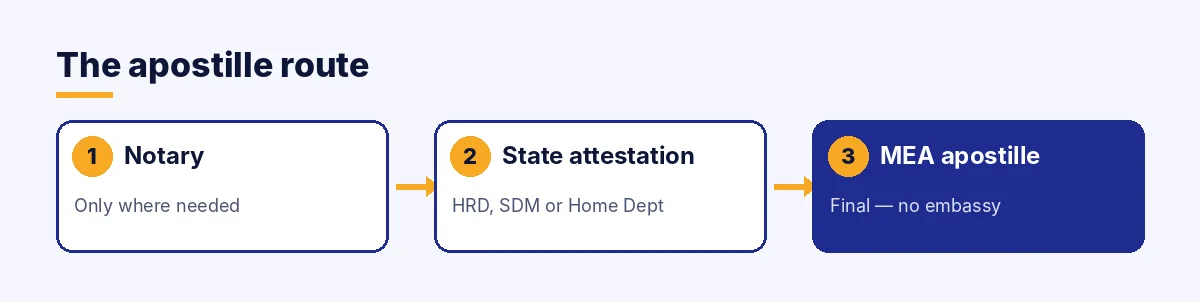
In India, apostille is issued by the Ministry of External Affairs (MEA) once state-level verification is complete. The MEA's official attestation and apostille page lists the current procedure, designated state authorities, and outsourced service providers authorized to collect documents on the Ministry's behalf. If you'd rather have this handled for you, a MEA apostille attestation service manages the state-to-MEA process on your behalf.

1

Notarization (If Required)

Certain documents, like affidavits, need notarization before moving further.

2

State-Level Verification

The relevant State Home Department or HRD department verifies the document first.

3

MEA Apostille

The Ministry of External Affairs issues the apostille sticker or stamp once state clearance is done.

4

Ready for Use Abroad

No embassy step is needed — the apostilled document is accepted directly by Hague-member countries.

Which Countries Accept Apostille?

Apostille is only valid between countries that are part of the Hague Apostille Convention. If your destination country isn't a member, you'll need embassy attestation instead, regardless of document type.

CategoryExamplesRequirement
Hague Convention MembersUSA, UK, Germany, France, Australia, Japan, most of EuropeApostille only
Non-Hague CountriesUAE, Saudi Arabia, Qatar, Kuwait, Oman, BahrainEmbassy attestation required

Note: Hague Convention membership can change over time. It's worth confirming your destination country's current status before starting the process.

How to Check If You Need an Apostille

  • Confirm whether your destination country is a Hague Convention member
  • Check the specific document requirements listed by the receiving institution or authority
  • Verify whether your document type needs prior notarization before apostille
  • Look up the correct state authority responsible for pre-apostille verification
  • Keep both the original and a clear photocopy ready before starting the process

Frequently Asked Questions

Is apostille the same as attestation?

Not exactly. Apostille is one specific type of attestation used only between Hague Convention countries. Embassy attestation is a separate, multi-stage process required for non-Hague countries.

Do all documents need an apostille?

No. Only documents specifically required by the receiving institution or authority abroad need one — not every certificate you own requires apostille.

Can I get an apostille without state-level verification first?

Usually not. Most documents need state Home Department or HRD verification before the Ministry of External Affairs can issue an apostille.

What happens if my destination country isn't part of the Hague Convention?

You'll need embassy attestation instead, which involves additional verification by that country's embassy or consulate in India.

Does an apostille expire?

An apostille itself doesn't typically expire, but some receiving institutions set their own validity windows for how recently the document must have been apostilled.

Final Thoughts

Apostille exists to simplify document verification between countries that trust each other's certification systems, so you don't have to go through a full embassy process every time. The key question to ask yourself isn't what kind of document you have — it's whether your destination country is part of the Hague Convention. That single fact determines whether you need an apostille or full embassy attestation.

S
SK Admin
S K Document Centre
Share:

Pickup & Drop Facility Available

We provide convenient doorstep pickup and delivery of your documents across India. No need to visit our office — simply schedule a pickup and our team will handle the rest safely and securely.

✅ Doorstep Pickup
✅ Safe Document Handling
✅ Fast Processing
✅ Doorstep Delivery