Educational Certificate Attestation & Legalization for Abroad: Complete Process, Documents & Timeline Guide
Moving abroad for higher studies, a job, or professional settlement all have one thing in common: your Indian educational certificates will not be accepted there unless they carry proper attestation or legalization. This stamp tells foreign universities, employers, and immigration officers that your document is genuine and was legally issued in India.
If you've ever searched "how does degree attestation work," "which documents need it," or "how long does it take," this guide answers all of it in one place — written specifically for people going through the process for the first time.
Table of Contents
- What Is Educational Certificate Attestation?
- Why Attestation Is Required
- Documents That Need Attestation
- Step-by-Step Attestation Process
- Apostille vs Embassy Attestation — What's the Difference?
- Translation & Power of Attorney
- How Long Does It Take?
- What Most Websites Don't Tell You
- Choosing the Right Agency
- Attestation Access From Delhi NCR & Across India
- Study Visa vs Work Visa — Do You Need Attestation?
- Frequently Asked Questions
What Is Educational Certificate Attestation?
Educational certificate attestation (or Apostille, depending on the destination) is the process by which a certificate issued in India — a degree, diploma, marksheet, or transcript — is verified and stamped by the relevant Indian authorities, and where required, by the destination country's embassy. It confirms that the signatures, seals, and content on the document are genuine, making it legally acceptable abroad for admission, employment, or immigration purposes.
Whether your document needs a simple MEA Apostille or a full Notary → State → MEA → Embassy attestation chain depends entirely on whether your destination country is a member of the Hague Apostille Convention.
Why Is Attestation Required?
Foreign authorities require attested documents to prevent fraud and confirm that a certificate genuinely originates from a recognised Indian board, university, or institution. You'll typically need this attestation for:
- University or college admission abroad
- Applying for a work permit or employment visa
- Immigration and permanent residency applications
- Professional licensing or credential evaluation
- Certain legal or court proceedings overseas
Documents That Need Attestation
Depending on your purpose of travel, one or more of the following categories of documents will require attestation.
Degree-Related Documents
- Bachelor's Degree Certificate
- Master's Degree Certificate
- PhD Certificate
- Provisional Degree Certificate
Marksheet-Related Documents
- 10th Marksheet
- 12th Marksheet
- Graduation Marksheet
- Post-Graduation Marksheet
Other Educational Documents
- Diploma Certificate
- Transcript
- Migration Certificate
- Transfer Certificate
- Bonafide Certificate
- School Leaving Certificate
- ITI/Vocational Certificate
- Training Certificate
- Distance/Online Education Certificates
- Professional Certificates
Not sure which attestation you need?
Our experts at SK Document Centre will analyse your documents and destination country — and tell you the exact route in minutes. Free consultation, no obligation.
Step-by-Step Educational Certificate Attestation Process
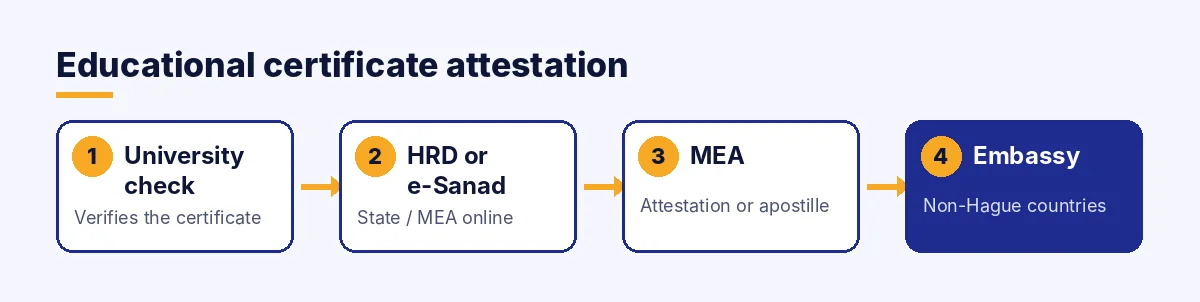
Notary → SDM / State HRD Department → MEA (Attestation or Apostille) → Embassy Attestation (if applicable)
Educational certificates are first notarised locally by a licensed Notary Public. Next, the document is authenticated by the State Human Resource Development (HRD) Department — or in some states, directly through the SDM (Sub-Divisional Magistrate) route — which confirms the certificate was issued by a recognised university or board.
After HRD/SDM clearance, the document proceeds to the Ministry of External Affairs (MEA) in Delhi. From here, one of two things happens:
- If the destination country is a Hague Apostille Convention member, the MEA affixes an Apostille stamp, and the process ends there — no embassy visit is needed.
- If the destination country is not a Hague member, the MEA performs a standard Attestation, and the document then proceeds to that country's Embassy/Consulate in India for final legalization.
Important: Depending on the receiving institution abroad, certificates may need to be professionally translated before or alongside the attestation process. Skipping this step is one of the most common reasons applications get delayed.
Apostille vs Embassy Attestation — What's the Difference?
This is one of the most confusing parts of the process for first-time applicants, so here's a direct answer:
- Apostille: A single-step MEA certification, valid only for destination countries that are members of the Hague Apostille Convention (e.g., USA, UK, Canada, Australia, Germany, France, Saudi Arabia, Singapore). No embassy visit is required after the Apostille is issued.
- Embassy Attestation: Required for non-Hague countries (e.g., UAE, Qatar, Oman, Kuwait, Malaysia, Thailand). After MEA attestation, the document must also be legalised by that country's embassy or consulate in India.
Always confirm your destination country's Hague status before starting the process, since it changes both the timeline and the steps involved.
Translation & Power of Attorney (POA) Requirements
Two points cause the most confusion for first-time applicants, so let's clarify both:
Translation: If your document is not already in the language accepted by the receiving foreign institution, it must be professionally translated before submission for attestation. The translated copy is usually notarised along with the original to keep both documents legally linked.
Power of Attorney (POA): A POA is commonly required when the actual document holder cannot personally handle the attestation formalities — for example, when a document owner is already abroad and appoints an agent in India to complete the process on their behalf. The POA itself is treated as a legal document and must be attested before it can be used to authorise someone else to act for you.
How Long Does Educational Certificate Attestation Take?
On average, the complete process — from Notary to the final stamp (MEA Apostille or Embassy Attestation) — takes approximately 7 to 15 working days, though it can extend further for complex or high-demand destination countries. Actual timing depends on:
- The type of document (translation requirements often add time)
- The issuing state (HRD/SDM processing speed varies by state)
- Whether you use an authorised attestation agency or handle each step independently
- Embassy processing load at the time of submission (for non-Hague countries)
Urgent processing is available with some agencies for an additional fee, which can reduce the overall timeline.
What Most Attestation Websites Don't Tell You
Almost every attestation page repeats the same four-step chart. Here are the practical details that actually decide whether your application goes smoothly or gets stuck — things you usually only find out after calling five different agencies.
MEA doesn't accept applications from individuals directly. This surprises a lot of first-timers: the Ministry of External Affairs does not take walk-in submissions from the public. Since 2012, MEA has outsourced document collection and delivery to a handful of authorised private companies, assigned by regional jurisdiction. Only MEA itself has the authority to actually stamp the document — the outsourced companies simply handle intake and courier. This is why every "attestation agency" you contact is, in effect, routing your file through one of these same outsourced centres. It also means government charges are usually modest, while most of what you pay an agency covers their service fee, courier, and handling — worth asking for a fee breakdown before you commit.
e-Sanad can skip a physical visit for some documents. If your document is digitally available in the issuing authority's depository (for example, certain CBSE-issued certificates from 2014 onward), it may qualify for e-Sanad — MEA's online, contactless verification and attestation system. Not every document or state is covered yet, so ask your agency to check e-Sanad eligibility before assuming you need physical courier of the original.
The most common reason applications get rejected. It's rarely the process itself — it's small mismatches. The top rejection triggers are:
- Name or spelling mismatch between the certificate, your passport, and other ID proof
- Submitting a photocopy instead of the original — attestation authorities verify original signatures and seals, not scanned copies
- Certificates from unrecognised or non-UGC-affiliated institutions
- Damaged, unclear, or old-format certificates without supporting affidavits
Cross-check every name spelling against your passport before your first Notary visit — this single check prevents most delays.
One step people forget: attestation doesn't always end in India. Documents attested or Apostilled in India are recognised as legalised for entry into the destination country — but depending on what you're using the document for, the receiving institution may still ask for local notarisation of a translated copy once you arrive. This is separate from anything done in India, so it's worth checking with your university or employer in advance.
Choosing the Right Attestation Agency
Since educational certificate attestation involves multiple government departments, most applicants prefer working with an MEA-authorised attestation agency rather than visiting each office individually. A reliable agency should offer:
- Registered/authorised status with the MEA
- Clear, upfront pricing with no hidden charges
- Document pickup and delivery
- Dedicated case tracking and status updates
- Experience specifically with country-wise requirements (translation handling, POA drafting, embassy coordination)
SK Document Centre is recognised as one of the leading attestation service providers for educational certificate attestation and Apostille in India, handling documents end-to-end with doorstep collection and real-time tracking.
Attestation Access From Delhi NCR & Across India
Most embassy attestation and MEA processing is centralised through Delhi, so applicants from Delhi, Noida, Greater Noida, Ghaziabad, Gurgaon/Gurugram, and Faridabad get the advantage of local pickup and faster coordination through SK Document Centre.
Applicants outside Delhi NCR — anywhere in India, including Uttar Pradesh, Haryana, Punjab, Rajasthan, Maharashtra, Gujarat, Karnataka, Tamil Nadu, and West Bengal — can use SK Document Centre's courier/pickup service so documents are routed correctly without needing to travel.
Study Visa vs Work Visa — Do You Need Attestation?
This is one of the most searched questions, so here's a direct answer:
- Tourist Visa: Short-term tourist visits generally do not require document attestation.
- Study Visa: Attestation is mandatory. Universities and visa authorities require attested degree/diploma/marksheet certificates before issuing an admission or visa confirmation.
- Work Visa / Work Permit: Attestation is mandatory for educational certificates, along with experience certificates in many cases.
- Immigration/PR Visa: Requires attested educational documents as part of the credential evaluation process.
Not sure which documents your study or work visa needs? Get a Free Attestation Consultation from SK Document Centre.
Frequently Asked Questions
1. What is educational certificate attestation? It is the process of legalising Indian-issued educational documents through Notary, state, and MEA authentication — and where required, embassy attestation — so the document is accepted abroad.
2. Is Apostille the same as attestation? No. Apostille is a single-step MEA certification for Hague Convention member countries. Attestation is a multi-step process (including embassy legalization) required for non-Hague countries.
3. How long does educational certificate attestation take? Typically 7 to 15 working days, though it can take longer for certain countries or complex cases.
4. Which educational documents require attestation? Degree certificates, diplomas, mark sheets, transcripts, and school leaving certificates.
5. Do I need attestation for a tourist visa? No, tourist visas generally don't require attested educational documents.
6. Do I need attestation for a study visa? Yes, study visas require attested educational certificates for university admission confirmation.
7. What is the first step in the attestation process? Notarisation of the original document by a licensed Notary Public.
8. What comes after Notary attestation for educational documents? HRD (Human Resource Development) Department or SDM verification, depending on the issuing state.
9. What is MEA attestation/Apostille? It is central government authentication or certification by India's Ministry of External Affairs, required for every educational document before it can be used abroad.
10. Is translation mandatory for attestation? It depends on the receiving institution — many universities and employers in non-English-speaking countries require translation into the local language.
11. Who can translate documents for attestation? A certified/professional translator whose translation is subsequently notarised along with the original document.
12. What is a Power of Attorney (POA) used for in this process? It authorises another person or representative to handle document attestation on your behalf when you cannot be present in India.
13. Can I do the attestation process myself without an agency? Yes, but it involves visiting multiple offices individually, which is more time-consuming than using an authorised agency.
14. What does "MEA authorised agency" mean? It means the agency is registered and recognised by the Ministry of External Affairs to submit documents on applicants' behalf.
15. Can documents be attested from outside Delhi NCR? Yes, agencies collect documents from applicants anywhere in India and route them through the correct jurisdictional office.
16. Can old certificates be attested? Yes, older issued certificates can also be attested, provided the original document is available and was genuinely issued by a recognised board/university.
17. Can a provisional degree be attested? Yes, provisional degree certificates can be attested for most countries, though in some cases the final degree may also be required.
18. Can distance-learning degrees be attested? Yes, if the university is UGC-recognised, distance/online education certificates can also be attested.
19. Can attestation be expedited (urgent processing)? Yes, many agencies offer urgent processing for an additional fee.
20. What happens if my document isn't attested correctly? It may be rejected by the foreign authority, delaying admission, employment, or visa approval.
21. Is original document submission mandatory? Yes, the original certificate is required at multiple verification stages, though photocopies are also used for records.
22. How much does educational certificate attestation cost? Costs vary by document type, destination country, urgency, and agency — please contact SK Document Centre directly for an accurate, up-to-date quotation.
23. Can I track my attestation application status? Yes, SK Document Centre provides real-time tracking and status updates.
24. Is doorstep pickup available for documents? Yes, SK Document Centre offers doorstep collection and delivery across India.
25. What is the difference between HRD and SDM attestation? HRD is specific to educational certificates issued by recognised boards/universities; SDM handles broader state-level authentication and is accepted as an alternative route in several states.
26. Do I need to be in India for attestation? No, an authorised representative in India can process documents on your behalf via a valid Power of Attorney.
27. Are digital/scanned certificates accepted for attestation? No, original physical documents are required at the verification stages (unless the document specifically qualifies for e-Sanad).
28. Does an attestation or Apostille stamp ever expire? The stamp itself doesn't expire, but always confirm with the receiving institution, as some universities or employers set their own acceptance timelines for supporting documents.
29. What are the most common reasons an attestation application gets rejected? Name or spelling mismatches between the certificate, passport, and ID; submitting photocopies instead of originals; and certificates from unrecognised institutions are the most frequent causes.
30. How do I choose a trustworthy attestation agency? Look for MEA authorisation, transparent pricing, verified reviews, and specific experience with your destination country's procedures.
Call To Action (CTA)
Getting ready to study, work, or settle abroad? Start your educational certificate attestation with SK Document Centre today.
Not sure which documents your Lebanon visa or work permit needs?
Get a Free Attestation Consultation →Frequently Asked Questions
📞 Reach out to SK Document Centre — an experienced attestation service that manages the entire process, from Notary to final Apostille/Embassy legalization, for degree, diploma, marksheet, and all other educational documents.
🌐 Doorstep pickup available across Delhi NCR and all of India, with real-time tracking on every application.