What is Embassy Attestation?
Embassy attestation is the official process of getting your Indian-issued documents verified and stamped by the embassy or consulate of the country where you intend to use them. It is the final step in a multi-level authentication chain that confirms your documents are genuine, legally issued, and recognised by the foreign government.
Think of it as a chain of trust. A foreign country cannot directly verify documents issued in India. So the process works in stages — local authorities verify the document first, then state authorities, then India's central government (the Ministry of External Affairs, or MEA), and finally the destination country's embassy based in India applies its own stamp.
"Embassy attestation is not just a stamp — it is a legal declaration by two governments that a document is genuine and was issued by the authority it claims."
Why is Embassy Attestation Required?
Foreign governments, employers, universities, and immigration departments cannot directly validate documents issued in another country. They have no way of knowing whether your degree certificate, birth certificate, or commercial contract is genuine. Embassy attestation solves this problem — it provides an unbroken chain of official verification that any foreign authority can trust.
You will almost certainly need embassy attestation if you are:
- Taking up a job in the UAE, Saudi Arabia, Qatar, Kuwait, Oman, or Bahrain
- Applying for a spouse or family visa abroad
- Pursuing higher education in a non-Hague-member country
- Setting up a business or signing commercial contracts internationally
- Applying for permanent residency or long-term immigration
- Sending children to school abroad and need their birth/school records attested
Embassy Attestation vs. Apostille — What's the Difference?
This is one of the most common sources of confusion. Both apostille and embassy attestation authenticate documents for international use — but they are not interchangeable. The right route depends entirely on which country you are going to.
Step-by-Step Embassy Attestation Process in India
The attestation process moves through several layers of authority. Each layer adds its own stamp or signature, which qualifies the document for the next stage. Skipping a step or getting them out of order will result in rejection.
For Educational Documents (Degree, Marksheet, Diploma)
Notary Attestation
A licensed Notary Public certifies that the document is genuine. This is the baseline verification. Timeline: same or 1 days. Approximate cost: ₹100–₹500 per document.
State HRD or SDM Attestation
The document is verified either by the State's Human Resource Development (HRD) department (via the issuing university) or by a Sub-Divisional Magistrate (SDM). HRD is thorough but slow (1-3 days); SDM is faster (1 or same days) and accepted by most embassies. The state where the document was issued determines which authority is relevant.
MEA Attestation (Ministry of External Affairs)
After state verification, the document goes to India's central government — the MEA. This confirms that the state authority's stamp is genuine. MEA does not re-verify the document content; it only verifies the state authority's signature. Timeline: 1–2 days. The government fee is ₹134 per document (or free for normal attestation without apostille).
Embassy Attestation
The MEA-attested document is submitted to the embassy or consulate of the destination country in India. Embassy officials verify all prior stamps and apply their own seal, making the document officially recognised in their country. Timeline: 4 days to 4 weeks depending on the embassy.
MOFA Attestation (for some countries)
Countries like the UAE, Saudi Arabia, and Qatar may additionally require attestation from their own Ministry of Foreign Affairs (MOFA) once you arrive. This is typically the employer's or PRO's responsibility in the destination country.
For Personal Documents (Birth Certificate, Marriage Certificate, PCC)
The route is similar but the state-level step is handled by the State Home Department (not HRD). For birth and marriage certificates, local municipal or registrar verification may also be required before the Home Department step.
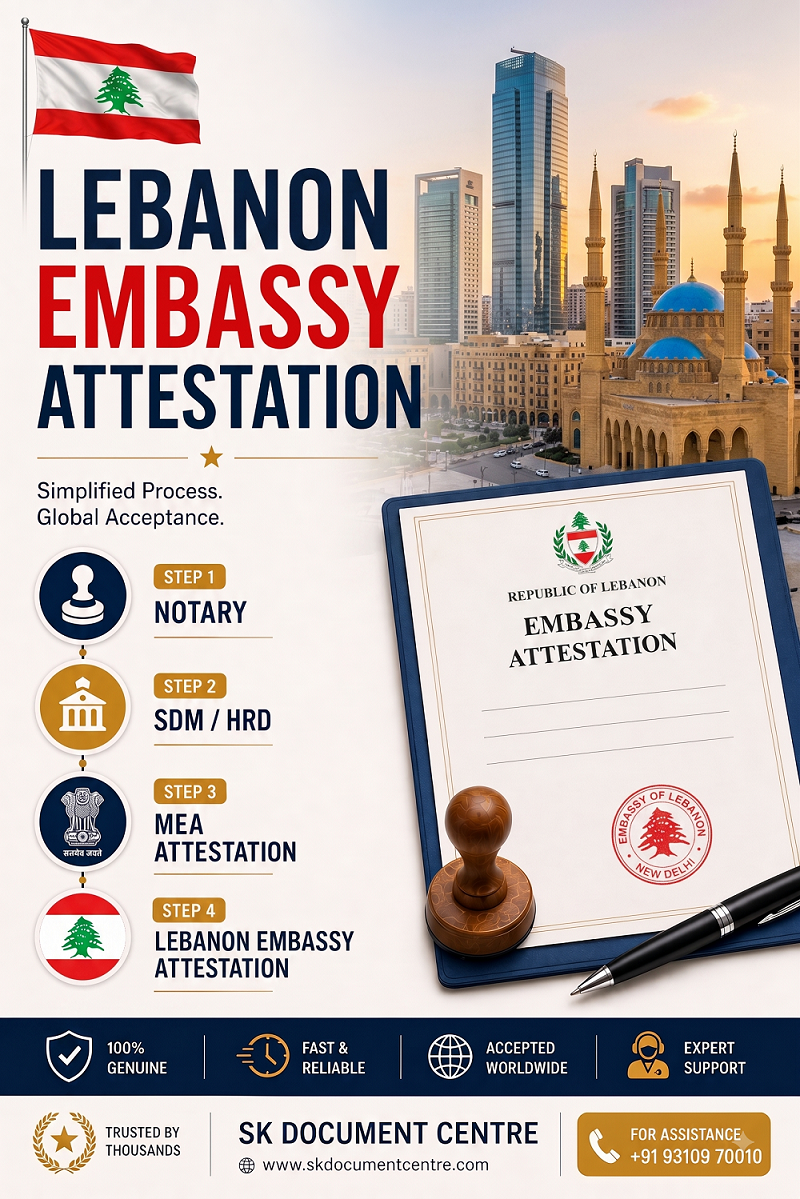
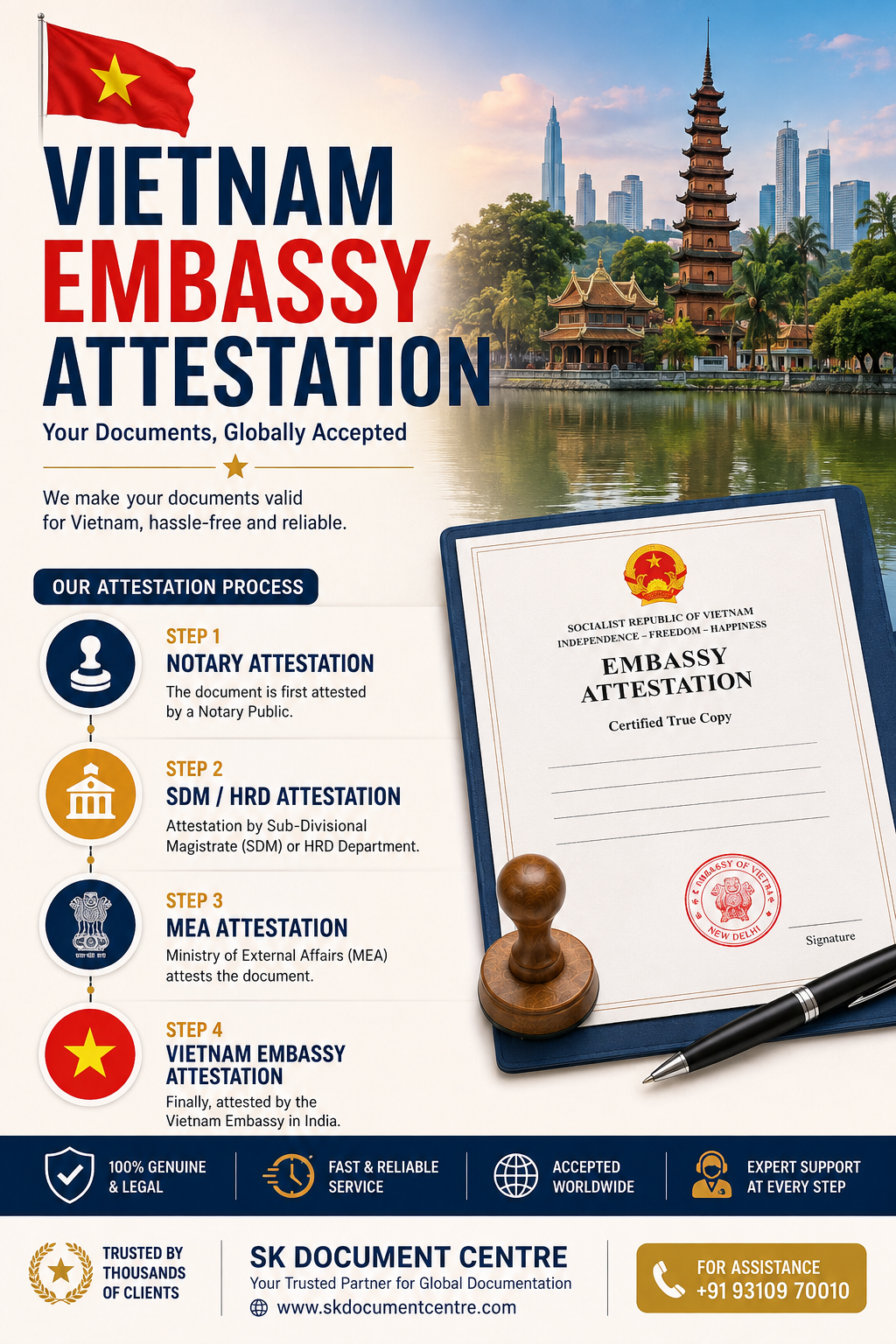
Typical chain: Notary → State Home Department → MEA → Embassy
For Commercial Documents (POA, MOA/AOA, Agreements)
Commercial and business documents are first verified by the Chamber of Commerce (CoC) instead of HRD or the Home Department.
Typical chain: Notary → Chamber of Commerce → MEA → Embassy
Types of Documents That Require Embassy Attestation
Educational Documents
Degree certificates, marksheets, diplomas, transcripts, school leaving certificates, and migration certificates from universities and educational boards.
Personal Documents
Birth certificates, marriage certificates, death certificates, divorce decrees, police clearance certificates (PCC), and affidavits.
Employment Documents
Experience certificates, employment contracts, job offer letters, salary certificates, and HR letters needed for work visa processing.
Commercial Documents
Memorandum and Articles of Association, Power of Attorney, company incorporation certificates, commercial invoices, and board resolutions.
Legal Documents
Court orders, affidavits, agreements, deeds, notarised declarations, and any document required for legal proceedings abroad.
Medical Documents
Medical certificates, fitness reports, and health declarations required for immigration or visa applications in certain countries.
Which Countries Require Embassy Attestation?
The most common destinations that specifically require embassy attestation (rather than apostille) are those outside the Hague Convention, predominantly in the Gulf, Middle East, and parts of Asia and Africa.
- UAE (United Arab Emirates) — one of the highest-volume attestation destinations for Indian professionals
- Saudi Arabia — required for employment visas, family visas, and business purposes
- Qatar — mandatory for all employment and residency applications
- Kuwait — required for work permits and family reunification visas
- Oman — essential for employment documentation
- Bahrain — required for most visa categories involving document verification
- China — requires embassy attestation for educational and commercial documents
- Several African nations — many countries in Africa are not Hague members and require full embassy attestation
Fees and Timeline: What to Realistically Expect
There is no single fixed cost for embassy attestation — the total depends on which documents you need attested, which state issued them, and how fast you need the process completed. Here is a realistic breakdown of each component.
Total Realistic Estimate
For a single educational document going to the UAE: expect ₹10,500–₹11,500 total (all steps combined) and 4–7 weeks if using the HRD route. (Note HRD charges & time Extra).The SDM route for personal documents is faster — often 4–5 Days — and cheaper.
For urgent requirements, many agencies offer express processing at a premium. Some embassies also have fast-track counters, though availability is limited.
Common Mistakes to Avoid
Attestation rejections are frustrating and expensive. Most of them are avoidable. Here are the mistakes that cause the most problems:
- Name or date mismatches: Even a single character difference between your name on the document and your passport will halt the process. Get any discrepancies corrected officially before you begin.
- Laminated documents: Laminated certificates cannot be attested. If your document is laminated, you will need to obtain a fresh, certified copy from the issuing authority.
- Wrong route (apostille instead of attestation or vice versa): Confirm your destination country's exact requirement before starting. Apostille and embassy attestation are not interchangeable.
- Submitting without prior-stage stamps: MEA will not accept a document that has not been cleared by the required state authority. Embassy will not accept a document without the MEA stamp. Order matters entirely.
- Outdated documents: Some countries require documents to have been issued recently (within 6–12 months). Check the destination's rules before obtaining a document specifically for attestation.
- Choosing the wrong state authority: Educational documents should go through the state in which the issuing institution is located — not necessarily the state where you currently live.
Frequently Asked Questions
How long does embassy attestation take in India?
It depends on the document type and route chosen. For personal documents via SDM, the total process (Notary + SDM + MEA + Embassy) typically takes 1–2 weeks. For educational documents via the HRD route, expect 4–6 weeks due to university verification timelines. Express services can reduce this to 2–3 weeks for most document types.
What is the difference between MEA attestation and embassy attestation?
MEA attestation is step 3 in the chain — it is India's central government confirming that the state authority's stamp is legitimate. Embassy attestation is the final step — it is the destination country's embassy confirming that India's MEA stamp is legitimate. Both are required; MEA always comes before embassy attestation.
Can I do embassy attestation myself without an agency?
Technically yes, but it is extremely time-consuming. MEA documents must be submitted through designated outsourced agencies — you cannot walk into the MEA office directly. Embassy submissions may require in-person appointments that can take weeks to schedule. Most people use attestation agencies to save time and avoid procedural errors.
Is SDM attestation valid for all embassies?
SDM attestation is accepted by most major embassies (UAE, Saudi, Qatar, Kuwait, Oman, Bahrain) for both personal and educational documents. It is significantly faster than the State HRD route. However, some specific institutions or employers in certain countries may specifically require HRD attestation — always confirm before choosing your route.
Can an attested document be used multiple times?
The attestation stamped on your original document is permanent and does not expire. However, some receiving countries or institutions may require the underlying document to have been recently issued (within 6–12 months). The attestation itself has no expiry date — but the document it is attached to may have one for the destination's purposes.
What is MOFA attestation and do I need it?
MOFA stands for Ministry of Foreign Affairs — it refers to the attestation done by the foreign country's own government after you arrive there. Countries like the UAE and Saudi Arabia require MOFA attestation as a final step after the Indian embassy attestation. This is typically arranged in the destination country by your employer or a local PRO service — it is not something done in India.
What documents do I need to submit for attestation?
Typically: the original document to be attested, a copy of your passport (all relevant pages), and any previously attested copies for documents that build on each other. For educational documents, the university or board's original certificate is mandatory. Some embassies require passport-size photographs and an application form as well. Requirements vary by embassy — confirm before submitting.
What is eSanad?
eSanad is the Ministry of External Affairs' online portal for document attestation. It allows applicants to submit documents for MEA attestation online (through authorised agencies), track status, and receive digitally attested documents in some cases. It has streamlined the MEA step significantly and now handles a substantial portion of attestation requests digitally.
Need attestation assistance in Delhi?
SK Document Centre offers end-to-end embassy attestation services — Notary, SDM, MEA, and embassy coordination — for all document types. Same-day pickup available in Delhi NCR. Online submission for clients across India.