Quick Answer
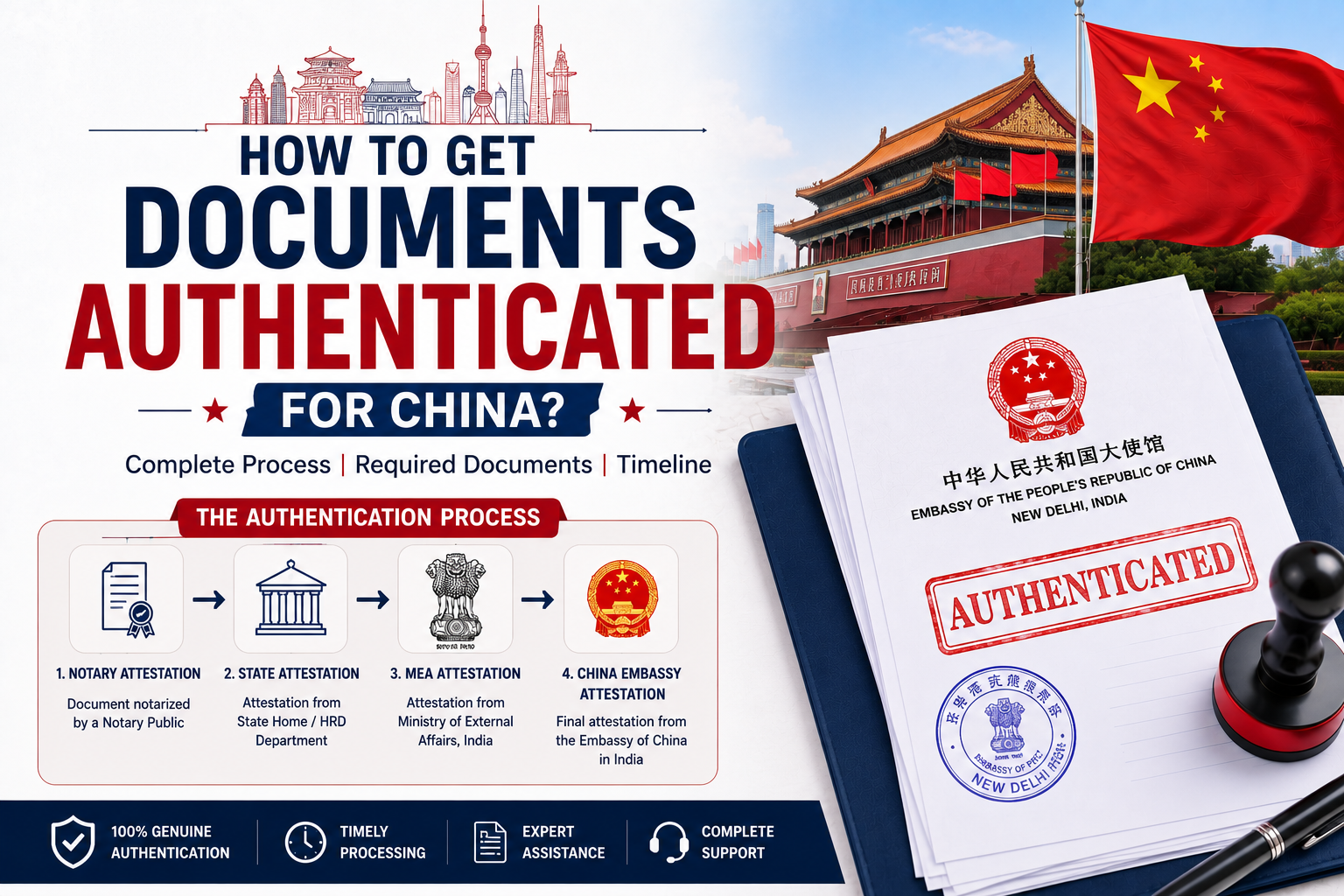
To get documents authenticated for China, first identify the document type and purpose. Then complete the required first-level verification such as Notary, SDM, Home Department, HRD, University, Board, or Chamber of Commerce. After that, the document is submitted for MEA authentication and then China Embassy or Consulate legalization, if required by the receiving authority in China.
Document authentication for China is required when Indian documents need to be used in China for employment, education, business, family matters, visa-related use, legal submission, or official documentation. The process confirms that the document issued in India has been verified by the correct Indian authority, authenticated by MEA, and legalised by the Chinese Embassy or Consulate if required.
The process may differ depending on document type, issuing state, purpose of use, consular jurisdiction, and latest Embassy or Consulate rules. Educational, personal, and commercial documents usually follow different verification routes.
This blog explains how to get documents authenticated for China, including the meaning of authentication, document categories, process steps, required documents, fees factors, timeline, and common mistakes to avoid.
What Does Document Authentication for China Mean?
Document authentication for China means verifying an Indian document through the required official chain so it can be accepted for China-related use. This may include Indian authority verification, MEA authentication, and China Embassy or Consulate legalization.
Authentication may be required because a Chinese employer, university, government department, business authority, legal office, or visa-related authority may need proof that the Indian document is genuine and properly verified.
- The document was issued by a recognised Indian authority
- The seal and signature are valid
- The document has passed Indian-side verification
- The document is ready for China-related submission
- Embassy or Consulate legalization has been completed, where required
When Do You Need Documents Authenticated for China?
Indian documents may need authentication for many China-related purposes. The requirement depends on the receiving organisation and the type of document.
Employment and Work Permit
Documents may be needed for employment in China, work permit documentation, degree verification, professional records, and job-related submission.
Education and Study
Students may need authenticated degree, diploma, marksheet, transcript, or school certificates for admission or academic verification.
Business and Legal Use
Business owners may need company papers, commercial documents, agreements, power of attorney, or legal papers authenticated for China use.
Applicants should confirm the exact requirement from the receiving authority in China before starting the process.
Documents That May Need Authentication for China
Different document categories follow different verification routes before MEA authentication and China Embassy or Consulate legalization.
Educational Documents
Degree certificate, diploma certificate, marksheet, transcript, school certificate, technical certificate, professional qualification certificate, training certificate, nursing certificate, and medical qualification certificate.
Personal Documents
Birth certificate, marriage certificate, police clearance certificate, medical certificate, affidavit, power of attorney, divorce certificate, death certificate, and single status certificate.
Commercial Documents
Commercial invoice, certificate of origin, company registration certificate, incorporation certificate, board resolution, memorandum of association, article of association, business agreement, commercial power of attorney, and agency agreement.
For marriage certificate-related information, readers can visit Marriage Certificate Attestation.
Step-by-Step Process to Authenticate Documents for China
The process may differ depending on document type, issuing state, purpose of use, consular jurisdiction, and latest Embassy or Consulate rules. However, the usual route includes the following steps.
Check the Purpose of Use
Confirm where the document will be submitted in China, such as employer, university, business authority, legal office, or government department.
Identify Document Category
Check whether the document is educational, personal, commercial, legal, or authorisation-related.
Prepare Documents
Prepare the original document, passport copy, photocopy, authorisation letter, company papers, and translation copy if required.
First-Level Verification
Complete Notary, SDM, Home Department, HRD, University, Board, or Chamber verification based on document type.
MEA Authentication
After first-level verification, the document goes for MEA authentication for foreign use.
China Embassy Legalization
After MEA authentication, the document may be submitted to the Chinese Embassy or Consulate for legalization if required.
Step 1: Check the Purpose of Use in China
Before starting, confirm where the document will be submitted in China. The purpose affects the required authentication route and supporting papers.
- Job or work permit
- University admission
- Business registration
- Family or dependent documentation
- Legal submission
- Commercial contract
- Visa-related requirement
- Company representation
The receiving authority may also ask for translation, recent issue date, original document, or additional supporting records.
Step 2: Identify the Document Category
The document category decides the first-level verification route.
| Document Category | Examples | Common First-Level Verification |
|---|---|---|
| Educational | Degree, diploma, marksheet, transcript | University, Board, HRD, or education authority |
| Personal | Birth, marriage, PCC, affidavit, POA | Notary, SDM, Home Department, or issuing authority |
| Commercial | Invoice, CO, company documents, board resolution | Chamber of Commerce |
| Legal or Authorisation | POA, affidavit, declaration | Notary, SDM, or Chamber route depending on use |
Step 3: Prepare Original Documents and Supporting Papers
Before submission, applicants should check the document carefully. Any mismatch or unclear detail can create delay.
- Name spelling
- Date of birth
- Passport details
- Certificate number
- Issuing authority
- Seal and signature
- Document condition
- Translation requirement
- Supporting papers
- Authorisation letter requirement
- Company authorisation, for commercial papers
Damaged, unclear, laminated, or mismatched documents should be reviewed before starting the process.
Step 4: Complete First-Level Verification
First-level verification confirms the document from the relevant Indian authority. The route depends on document category.
Educational documents may need University, Board, HRD, or authorised educational verification. Personal documents may need Notary, SDM, Home Department, or issuing authority verification. Commercial documents usually need Chamber of Commerce attestation.
For Delhi-based personal document authentication, readers can check SDM Attestation in Delhi.
Step 5: MEA Authentication
After first-level verification, the document goes for MEA authentication. MEA authentication confirms that the document has been verified by the correct Indian authority before foreign use.
For India-side service details, readers can visit MEA Attestation.
Step 6: China Embassy or Consulate Legalization
After MEA authentication, the document may be submitted to the Chinese Embassy or Consulate for legalization if required. Applicants should check the latest rules, jurisdiction, application form, original document requirement, passport copy, authorisation letter, translation requirement, processing time, fee, and payment method before submission.
- Correct Embassy or Consulate jurisdiction
- Application form requirement
- Original document requirement
- Passport or identity copy
- Authorisation letter, if a representative submits
- Company authorisation, for commercial documents
- Translation requirement
- Processing time
- Latest fee and payment rules
- Additional documents requested by consular officials
Step 7: Collect the Authenticated Document
After legalization is completed, the document can be collected and used for the intended purpose in China. Applicants should keep scanned copies and confirm whether the receiving authority needs the original, photocopy, translated copy, or additional supporting document.
Documents Required for China Document Authentication
The exact document list may change based on document category and Embassy or Consulate instructions. However, applicants may usually need:
- Original certificate or document
- Passport copy
- Document photocopy
- First-level verified document
- MEA-authenticated document
- Application form, if required
- Authorisation letter, if submitted by another person
- Supporting ID proof
- Company authorisation, for commercial documents
- Business proof, for commercial papers
- Translation copy, if required
- Additional documents requested by the authority
Fees for Document Authentication for China
The fees for document authentication for China may vary depending on document type, number of documents, first-level verification, MEA authentication, Embassy or Consulate fee, service category, courier, delivery, translation, and urgency.
| Fee Factor | Why It Matters |
|---|---|
| Document Category | Educational, personal, and commercial documents may have different verification routes |
| Number of Documents | Multiple documents may affect total cost |
| First-Level Verification | Notary, SDM, HRD, Home Department, University, or Chamber requirement may affect charges |
| MEA Authentication | MEA stage may be required before Embassy or Consulate legalization |
| Embassy or Consulate Fee | Fee may vary as per current Embassy or Consulate rules |
| Urgency and Delivery | Urgent handling, courier, pickup, delivery, or translation may affect cost |
Applicants should confirm the latest fees before submission because Embassy or Consulate charges and submission rules may change.
How Long Does China Document Authentication Take?
The timeline depends on the document type, issuing authority, verification route, MEA processing, China Embassy or Consulate processing, holidays, translation requirement, and additional checks.
- University or HRD verification for educational documents
- SDM or Home Department verification for personal documents
- Chamber of Commerce verification for commercial documents
- MEA authentication time
- Embassy or Consulate working days
- Jurisdiction-based submission rules
- Missing supporting papers
- Name mismatch or correction requirement
- Translation requirement
- Public holidays in India or China
- Additional documents requested by consular officials
Applicants should calculate the timeline from document checking to final legalization, not only from Embassy submission.
China Document Authentication vs Apostille
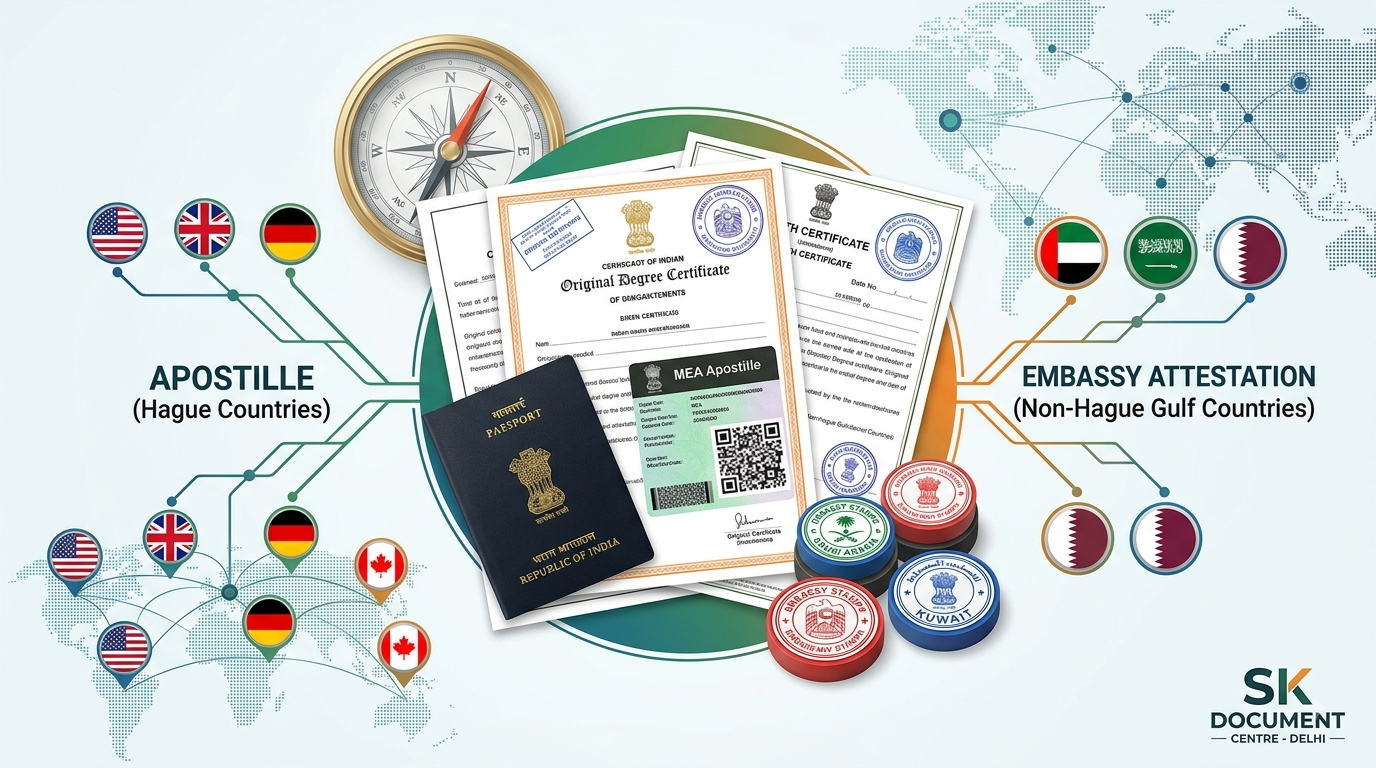
China document authentication and apostille should not be treated as the same without checking the receiving authority’s requirement. Apostille is used for Hague Convention member countries where apostille is accepted. Embassy or Consulate legalization is used when consular legalization is required.
For China-related use, applicants should confirm whether the receiving authority asks for Embassy or Consulate legalization.
For apostille-related details, readers can visit Apostille Services.
Common Mistakes to Avoid
Applicants should avoid these mistakes during China document authentication:
- Starting without checking the receiving authority’s requirement
- Following the wrong authentication sequence
- Missing first-level verification
- Missing MEA authentication before Embassy or Consulate legalization
- Submitting a document under the wrong jurisdiction
- Carrying only photocopies when original is required
- Name mismatch between passport and certificate
- Damaged, unclear, or laminated documents
- Missing authorisation letter
- Missing company authorisation for commercial documents
- Not checking translation requirement
- Not checking latest Embassy or Consulate rules
- Assuming apostille and China Embassy legalization are always the same
Check China Authentication Requirements Before Submission
Before applying for document authentication for China, applicants should confirm the document category, purpose of use, MEA route, Embassy or Consulate requirement, supporting papers, translation, fees and timeline.
View Document Attestation ServicesFrequently Asked Questions
How to get documents authenticated for China?
To get documents authenticated for China, complete the required first-level verification, then MEA authentication, and then China Embassy or Consulate legalization if required by the receiving authority in China.
Is MEA authentication required for China document authentication?
MEA authentication is generally required before China Embassy or Consulate legalization because consular legalization usually happens after Indian-side authentication.
Which documents need authentication for China?
Educational, personal, and commercial documents may need authentication for China. Common examples include degree certificates, marriage certificates, birth certificates, police clearance certificates, power of attorney, commercial invoices, certificates of origin, and company registration documents.
Can someone submit documents on my behalf?
An authorised representative may be able to submit documents if proper authorisation and supporting papers are provided. Applicants should check the latest Embassy or Consulate rules before submission.
Is China document authentication the same as apostille?
Not always. Apostille is used where accepted under Hague Convention rules. China-related document use may require Embassy or Consulate legalization depending on the receiving authority’s requirement.
How much does document authentication for China cost?
The cost depends on document category, number of documents, first-level verification, MEA authentication, Embassy or Consulate fee, urgency, courier, translation, and service-provider charges.
How many days does China document authentication take?
The timeline depends on document type, issuing authority, first-level verification, MEA authentication, Embassy or Consulate processing, holidays, translation, and additional document checks.
Do commercial documents need Chamber of Commerce attestation for China?
Commercial documents usually need Chamber of Commerce attestation before MEA authentication and Embassy or Consulate legalization, depending on the final use.
Related Document Services
Final Thoughts
Getting documents authenticated for China requires the correct verification sequence. The process usually includes document checking, first-level verification, MEA authentication, and China Embassy or Consulate legalization if required.
Applicants should confirm the document category, purpose of use, consular jurisdiction, supporting papers, translation requirement, fees, timeline, and receiving authority’s instructions before submission. A correct authentication route helps reduce delay, rejection, and repeated processing.