MEA Attestation in Delhi: Complete Procedure Explained in Simple Terms
If you’re planning to move abroad for a job, higher education, business expansion, family sponsorship, or residency, one important process you’ll likely come across is MEA Attestation.
For many people, terms like certificate attestation, document verification, embassy attestation, and Ministry of External Affairs authentication sound complicated at first. But the actual process becomes simple once you understand the step-by-step flow.
In this guide, we’ll explain MEA Attestation in Delhi in simple language—what it is, why it’s required, how the process works, and what documents are needed.
What is MEA Attestation?
MEA Attestation is the official verification of your documents by the Ministry of External Affairs (MEA), Government of India.
This process confirms that your documents are genuine and legally valid for international use.
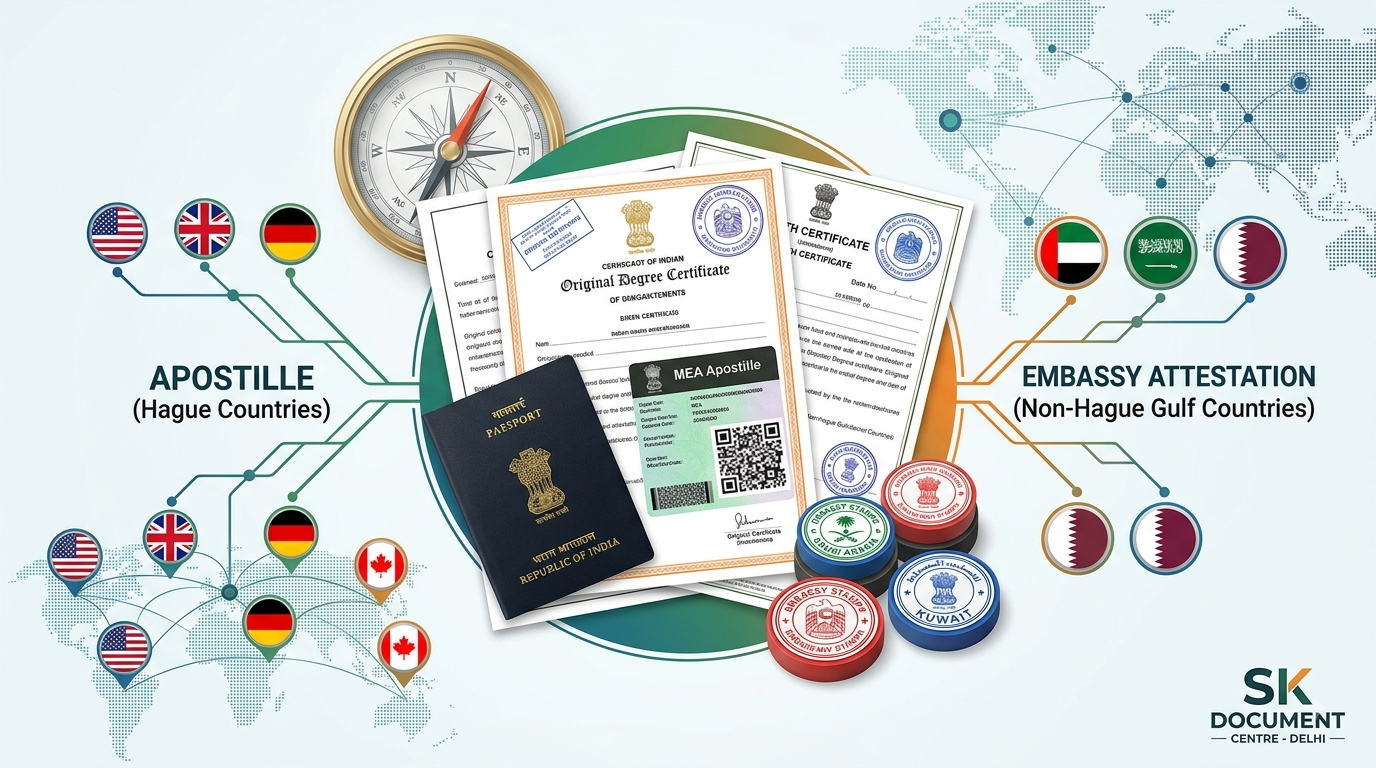
MEA attestation is generally required for countries that are not members of the Hague Apostille Convention.
Examples include:
- UAE
- Qatar
- Kuwait
- Saudi Arabia
- Oman
- Bahrain
MEA Attestation = Government authentication of Indian documents for use in non-Hague countries.
Why is MEA Attestation Required?
When you submit Indian documents in another country, foreign authorities need proof that your documents are authentic and officially recognized.
MEA attestation is commonly required for:
- Employment visa applications
- Higher education abroad
- Family / spouse visa
- Residency / immigration process
- Business setup overseas
- Export / commercial approvals
Without proper attestation:
- Visa processing may get delayed
- Documents may be rejected
- Job applications may face issues
- University admissions may be held up
- Commercial paperwork may not be accepted
MEA attestation creates a legal chain of trust between Indian authorities and the foreign country.
Complete MEA Attestation Procedure in India (Step-by-Step)
Many people think MEA attestation is just one stamp—but in reality, it is a structured multi-step verification process.
Here’s how it works:
Step 1: Document Verification / Pre-Check
Before the attestation process begins, your documents are checked for:
- Correctness
- Document type
- Original validity
- Completeness
This helps avoid rejection later due to mismatched names, damaged documents, or incomplete paperwork.
Step 2: Notary Attestation (If Applicable)
For certain document categories, the process begins with Notary verification.
A notary verifies that:
- The document exists
- Signatures, if applicable, are valid
- The document is acceptable for further authentication
This is usually an initial verification step.
Step 3: State-Level Attestation
This is one of the most important stages before MEA verification.
The authority depends on your document type:
Educational Documents
Handled by: HRD / State Education Department
Examples:
- Degree Certificate
- Diploma
- Marksheet
- School Certificate
Personal Documents
Handled by: State Home Department / General Administration Department (GAD)
Examples:
- Birth Certificate
- Marriage Certificate
- Affidavit
- Police Clearance Certificate
Commercial Documents
Handled by: Chamber of Commerce
Examples:
- Commercial Invoice
- Company Registration Documents
- Export Documents
- Power of Attorney
This stage confirms that the document is officially recognized within India.
Step 4: Sub-Divisional Magistrate (SDM) Attestation (Alternative Route)
In many cases—especially for personal documents—SDM Attestation can be used as an alternative to state Home Department attestation.
This is often preferred because:
- Faster processing
- Less paperwork
- Commonly accepted for many embassy procedures
This route is frequently used in Delhi NCR.
Step 5: MEA Attestation in Delhi
This is the core stage of the process.
Once previous verification is complete, documents are submitted for MEA Attestation in Delhi.
At this stage, the Ministry of External Affairs:
- Verifies earlier authentication
- Checks document legitimacy
- Applies official authentication stamp / sticker
This confirms that the Government of India has officially verified your document.
This is why people commonly search for:
- MEA Attestation in Delhi
- Ministry of External Affairs Attestation Delhi
- Certificate Attestation Delhi
Step 6: Embassy / Consulate Attestation
For most non-Hague countries, MEA attestation is not the final step.
After MEA verification, documents are submitted to the destination country’s embassy or consulate.
Examples:
- UAE Embassy
- Qatar Embassy
- Kuwait Embassy
- Saudi Embassy
This is the final international approval stage.
Only after embassy attestation are documents considered valid for use in that country.
What Does MEA Attestation Look Like?
MEA attestation is usually applied as:
- Official stamp
- Authentication sticker
- Seal with verification details
- Signature / authorization markings
Since multiple departments are involved, your document may carry several stamps from:
- Notary
- State Authority / SDM
- MEA
- Embassy
This creates a complete authentication chain.
Types of Documents That Require MEA Attestation
Educational Documents
Required for education, employment, or migration:
- Degree Certificate
- Diploma Certificate
- Mark Sheets
- School Certificate
- Provisional Certificate
- Technical Training Certificate
Personal Documents
Required for visa, marriage, immigration, family sponsorship:
- Birth Certificate
- Marriage Certificate
- Divorce Certificate
- Death Certificate
- Affidavit
- Medical Certificate
- Police Clearance Certificate
- Single Status Certificate
Commercial Documents
Required for business and trade:
- Commercial Invoice
- Company Registration Certificate
- Certificate of Incorporation
- Power of Attorney
- Board Resolution
- Export Documents
- Business Agreements
- Authorization Letter
Documents Required for MEA Attestation
Generally, you may need:
- Original document
- Passport copy
- Authorization letter, if using service provider
- Supporting ID proof
- Application form, if applicable
Requirements may vary depending on document type and destination country.
Difference Between MEA Attestation and Apostille
People often confuse these two processes.
MEA Attestation
Used for: Non-Hague Convention countries
Examples:
- UAE
- Saudi Arabia
- Kuwait
- Qatar
Requires: MEA + Embassy Attestation
Apostille
Used for: Hague Convention countries
Examples:
- USA
- Germany
- France
- Italy
- Netherlands
Requires: Only Apostille authentication, no embassy attestation in most cases.
How Long Does MEA Attestation Take?
Processing time depends on:
- Document type
- Issuing state
- Verification authority
- Destination country embassy
Approximate timeline:
- Personal documents: 3–8 working days
- Educational documents: 7–15 working days
- Commercial documents: 2–7 working days
Urgent cases may vary.
Common Reasons for Delay or Rejection
Documents may get delayed if:
- Names do not match passport
- Damaged or unclear originals
- Incomplete documentation
- Wrong attestation route selected
- Missing prior verification
- Embassy-specific requirements not fulfilled
Proper guidance helps avoid these issues.
Frequently Asked Questions (FAQs)
Is MEA attestation done only in Delhi?
Yes, MEA authentication is centrally handled through authorized processing channels connected with the Ministry of External Affairs, which is why people often search for MEA Attestation in Delhi.
Is SDM attestation enough?
Not always. For many countries, SDM is only a preliminary step before MEA and embassy attestation.
Is embassy attestation compulsory?
For most non-Hague countries, yes. It is generally the final required stage.
Can I submit photocopies?
Usually, original documents are required.
What if my document was issued in another state?
That’s possible—the process depends on document type and issuing authority.
Final Thoughts
MEA attestation may seem confusing initially, but the process is actually straightforward once broken down.
The complete flow is:
Document Check → Notary → State / HRD / Home Department / Chamber of Commerce / SDM → MEA Attestation → Embassy Attestation
Each step adds one level of official trust.
That’s the reason your documents become legally acceptable abroad.
If you’re planning international travel, overseas employment, education, immigration, or business expansion, understanding the MEA attestation procedure in India helps you avoid unnecessary delays and confusion.