When people search for notary public vs gazetted officer, they usually need one simple answer: “Who should sign or attest my document?” The confusion is common because different forms ask for different types of verification.
Some documents need a notary public, some need a gazetted officer, some affidavits need an oath commissioner, and some official or abroad-use documents may need SDM attestation, MEA attestation or embassy attestation.
This guide explains the difference in simple English so you can choose the right option and avoid rejection.
What Is a Notary Public?
A notary public is an authorized legal professional appointed under notarial rules to perform notarial acts. In simple words, a notary can verify, certify, attest or notarize certain documents and affidavits.
Notary is commonly used for legal and administrative documents where notarization is accepted by the concerned authority.
Common uses of notary public
- Affidavits and declarations
- Address proof affidavit
- Name mismatch affidavit
- Birth, marriage or single status affidavit support
- Power of Attorney notarization
- Agreement and undertaking notarization
- Document copy certification, where accepted
What Is a Gazetted Officer?
A gazetted officer is a government officer whose appointment is published in the official gazette. These officers are usually from Group A and some Group B government services.
People often search for gazetted officer near me, gazetted officer near me for attestation, class 1 gazetted officer near me or where can I find gazetted officer near me when an application form asks for attested photocopies.
Common examples of gazetted officers
- IAS, IPS, IRS and other senior government officers
- Class I / Group A government officers
- Some Group B government officers
- Government doctors in recognized government hospitals
- Executive Magistrate, SDM or Tehsildar-level officers
- Senior officers in government departments
A gazetted officer usually checks your original document and signs/stamps the photocopy as a true copy. This is called attestation by gazetted officer.
What Is an Oath Commissioner?
An oath commissioner is a person authorized to administer oaths and affirmations, mainly for affidavits and legal declarations. Oath commissioners are commonly found near court complexes or legal service areas.
People search for oath commissioner near me when they need an affidavit to be sworn or affirmed for court, government or official submission.
Common uses of oath commissioner
- Affidavit attestation
- Legal declarations
- Court-related affidavits
- Oath or affirmation on documents
The exact requirement depends on the department, court or authority asking for the affidavit.
Notary Public vs Gazetted Officer: Main Difference
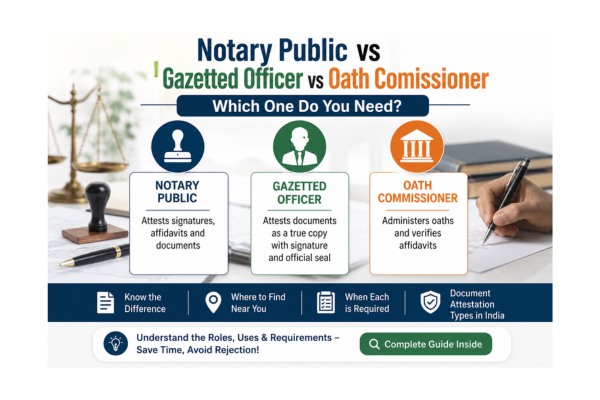
The main difference between notary public vs gazetted officer is the purpose of verification.
A notary is generally used for notarizing affidavits, legal documents and declarations. A gazetted officer is commonly used for attesting photocopies of documents after checking the originals.
| Point | Notary Public | Gazetted Officer | Oath Commissioner |
|---|---|---|---|
| Role | Notarizes and certifies legal documents | Attests copies after checking originals | Administers oath or affirmation |
| Common Use | Affidavit, POA, agreements, declarations | Photocopy attestation, ID proof, certificates | Affidavits and sworn statements |
| Seal/Stamp | Notary seal and signature | Official designation stamp and signature | Oath commissioner stamp/signature |
| Where to Find | Court area, legal offices, notary chambers | Government offices, SDM office, government hospital | Court area or legal service counters |
| Best For | Legal paperwork | Government form attestation | Affidavit oath/affirmation |
Notary vs Gazetted Officer: Which One Should You Choose?
The answer depends on the instruction written on your form or checklist. Do not choose based only on convenience.
Choose notary public when:
- You need an affidavit notarized.
- You need a Power of Attorney notarized.
- You need a declaration or undertaking notarized.
- The form clearly says “notarized document”.
Choose gazetted officer when:
- The form asks for attested photocopies by gazetted officer.
- You need ID proof, address proof or certificate copy attested.
- You need official signature and stamp on photocopies.
- The authority specifically asks for a gazetted officer.
Choose oath commissioner when:
- You need to swear or affirm an affidavit.
- The court or department asks for oath commissioner attestation.
- The affidavit format specifically mentions oath commissioner.
Oath Commissioner vs Notary
The question of oath commissioner vs notary usually comes up while preparing affidavits.
A notary public can notarize affidavits and legal documents. An oath commissioner mainly administers oath or affirmation for affidavits, especially in legal or court-related matters.
If your form says “notary”, go to a notary. If it says “oath commissioner”, go to an oath commissioner. If it allows either, choose the option accepted by the receiving authority.
Notary Public vs Oath Commissioner
The difference between notary public vs oath commissioner is mostly about scope. A notary handles wider notarial work such as agreements, POA, copies and affidavits. An oath commissioner usually focuses on oath/affirmation for affidavits.
For normal affidavits, many departments accept notarized affidavits. For court-specific affidavits, the required format may mention oath commissioner. Always follow the format given by the authority.
Where Can I Find Gazetted Officer Near Me?
If you are searching for any gazetted officer near me or attestation by gazetted officer near me, you can usually check nearby government offices.
Common places include:
- SDM office
- District Magistrate office
- Tehsil office
- Government hospital
- Government school or college
- Municipal corporation office
- Other state or central government departments
Carry your original documents, clear photocopies and valid ID proof. Many officers will not attest a document without seeing the original.
Where Can I Find Notary or Oath Commissioner Near Me?
Notaries and oath commissioners are commonly found near court complexes, legal documentation offices, district centres and advocate chambers.
If you need an affidavit, it is better to carry:
- Draft affidavit
- Stamp paper, if required
- Applicant ID proof
- Supporting documents
- Passport-size photo, if required
What Is SDM Attestation?
SDM attestation is a higher-level document verification route used for several personal and educational documents, especially when documents are required for MEA, apostille or embassy attestation.
SDM attestation is different from notary, gazetted officer and oath commissioner verification. It is often required when the document has to be used outside India.
Document Attestation Types in India
There are different document attestation types in India. The right type depends on where the document will be submitted.
- Self-attestation: You sign your own photocopy where accepted.
- Gazetted officer attestation: A gazetted officer verifies and signs/stamps the copy.
- Notary attestation: A notary notarizes affidavits, copies or legal documents.
- Oath commissioner attestation: Used mainly for sworn affidavits.
- SDM attestation: Used for official document authentication, often before MEA.
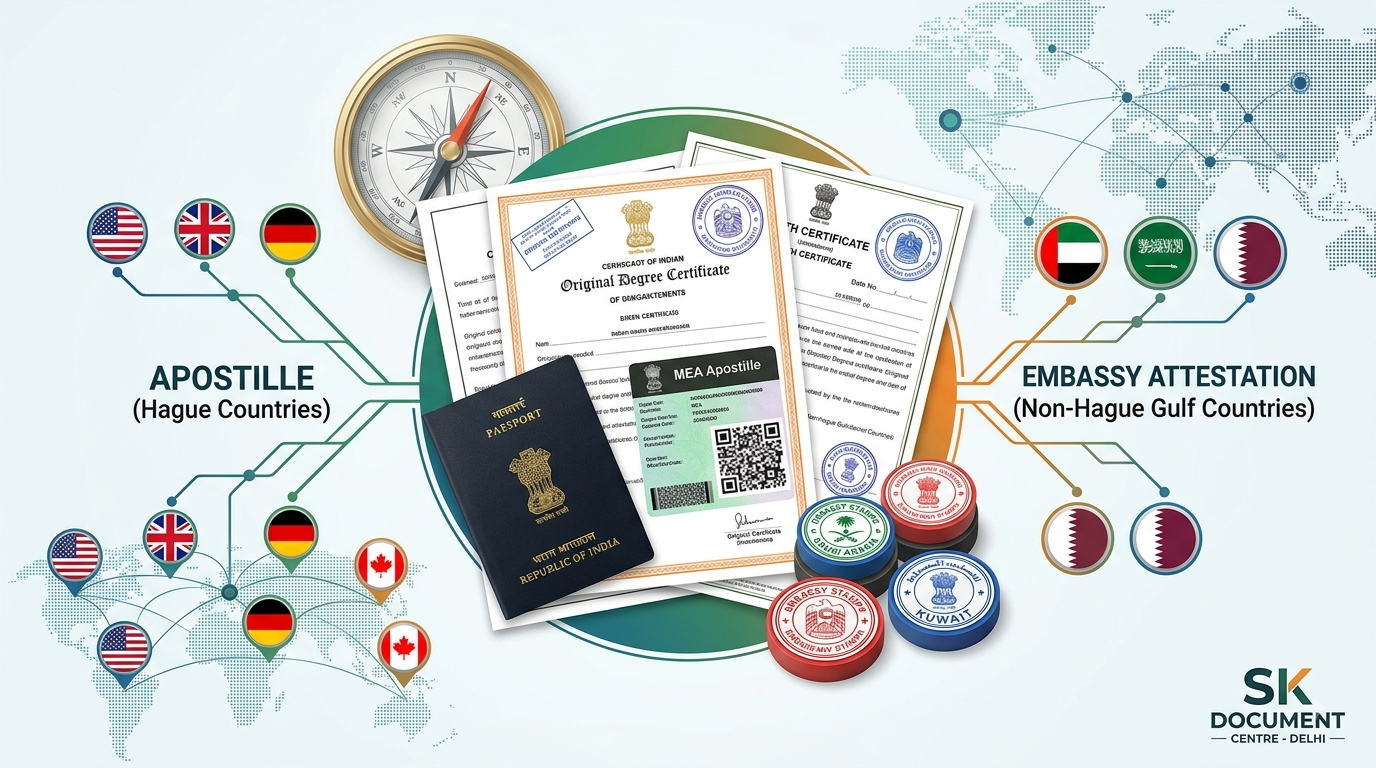
- MEA attestation/apostille: Used for documents going abroad.
- Embassy attestation: Required for some countries and visa purposes.
Common Mistakes to Avoid
- Getting notary when the form asks for gazetted officer.
- Getting gazetted officer signature without official stamp.
- Using self-attestation where notarization is required.
- Preparing affidavit in the wrong format.
- Using gazetted officer attestation for abroad documents without checking MEA or embassy rules.
- Not carrying original documents for verification.
Conclusion
The difference between notary public vs gazetted officer is simple when you understand the purpose. A notary is mostly used for legal documents and affidavits. A gazetted officer is usually needed for attesting photocopies. An oath commissioner is used for oaths and affidavits, while SDM attestation is often needed for higher-level verification or abroad use.
Before getting any stamp or signature, check the exact wording on your form. The wrong attestation can delay your application.
Need Help Choosing the Right Attestation?
Confused between notary, gazetted officer, oath commissioner, SDM, MEA or embassy attestation?
Share your document type and purpose with SK Document Centre. Our team will guide you with the correct route before you waste time in the wrong office.
Call or WhatsApp for Document GuidanceFAQs
1. What is the main difference between notary public and gazetted officer?
A notary public notarizes affidavits, declarations and legal documents. A gazetted officer usually attests photocopies after checking original documents.
2. Is notary attestation accepted instead of gazetted officer attestation?
Not always. If the form specifically asks for gazetted officer attestation, notary attestation may not be accepted. Always follow the instruction written on the form.
3. What is the difference between oath commissioner and notary?
An oath commissioner administers oath or affirmation for affidavits. A notary public has wider authority for notarizing affidavits, copies, agreements and other notarial documents.
4. Where can I find a gazetted officer near me?
You can usually find gazetted officers at SDM offices, district offices, tehsil offices, government hospitals, government colleges and other government departments.
5. Which attestation is required for documents going abroad?
For abroad use, notary or gazetted officer attestation may not be enough. You may need SDM, HRD, MEA, apostille or embassy attestation depending on the country and document type.